

If you’re new to gold investing, you’ve probably noticed that not all gold coins are sold the same way. Some are priced almost exactly at the value of their gold content. Others, often older and more ornate, carry price tags that seem to have little to do with how much gold they actually contain. This is the core distinction between bullion coins and historical (numismatic) gold coins, and understanding it is essential before you spend a single pound or dollar on gold.
This article breaks down exactly what separates these two categories, compares them across the factors that matter most to investors — liquidity, premiums, volatility, and collector value — and helps you decide which approach (or combination of both) makes the most sense for your goals. Whether you’re a complete beginner building your first gold position or a more experienced investor weighing whether to diversify into numismatics, you’ll come away with a clear framework for making the right call.
Let’s start by defining each category properly.
Prefer to listen?
This article is also available as a podcast episode.
Listen to this episode on Spotify
What Are Bullion Coins?
Bullion coins are gold coins minted specifically for investment purposes, with their value tied directly to the current market price of gold — known as the spot price. They’re produced in standardised weights, most commonly 1 troy ounce, along with smaller fractional sizes like 1/2 oz, 1/4 oz, and 1/10 oz.
The defining feature of a bullion coin is that its price is transparent and predictable. If the spot price of gold is, say, $2,400 per ounce, a 1 oz bullion coin will typically sell for that price plus a modest premium — usually somewhere between 3% and 8% — to cover minting, distribution, and dealer margin. This means you always know roughly what you’re paying for, and you can compare prices across dealers easily.
Well-known examples include the American Gold Eagle, the Canadian Maple Leaf, the South African Krugerrand, and the British Britannia. These coins are produced in massive volumes every year by government mints, and their primary purpose is to give everyday investors and institutions an accessible, liquid way to own physical gold. They are not generally valued for their design, rarity, or age — though some do have collector followings — but rather purely as a vehicle for gold ownership.
Because bullion coins are minted in such large quantities and are universally recognised, they trade with minimal friction. A dealer in London, Tokyo, or New York can quote a price on a Krugerrand or Maple Leaf almost instantly, without needing to research or authenticate the specific coin. This is precisely why bullion coins are the default starting point for most new gold investors — the value proposition is simple, transparent, and easy to verify.
If bullion is the route you’re considering, our comparison of the top gold bullion coins breaks down the Eagle, Maple Leaf, Krugerrand, and Britannia in detail.
What Are Historical Gold Coins?
Historical gold coins, also called numismatic coins, are older coins that carry value beyond their gold content. This additional value comes from a combination of factors: rarity, historical significance, condition (referred to as “grade”), mint origin, and demand among collectors. Many historical gold coins were originally minted for circulation as actual currency, decades or even centuries ago, before being withdrawn and becoming collector items.
A famous example is the US $20 Double Eagle, minted between 1849 and 1933. While its gold content might be worth a certain amount based on today’s spot price, a well-preserved specimen — particularly a rare date or mint mark — can sell for many multiples of that gold value, sometimes reaching tens of thousands of dollars for exceptional examples. Other widely traded historical coins include British Sovereigns from the 19th century, French Napoleons, and pre-1933 US gold coins of various denominations.
What makes historical coins fundamentally different from bullion is that their pricing isn’t tied to a simple formula. Two coins with identical gold content can have wildly different values depending on their grade, rarity, and collector demand. A coin in poor condition might sell close to its melt value, while the same coin in pristine, professionally graded condition could be worth ten or twenty times as much.
This is also why numismatic investing requires specialist knowledge. Grading services such as PCGS (Professional Coin Grading Service) and NGC (Numismatic Guaranty Company) assess coins on a standardised scale and encapsulate them in tamper-proof holders, which helps establish trust and a verifiable market value. Without this kind of expertise — or a graded coin from a reputable service — it’s genuinely difficult for a non-specialist to judge whether a numismatic coin is fairly priced.
Get our free 2026 Gold Investment Starter Pack here
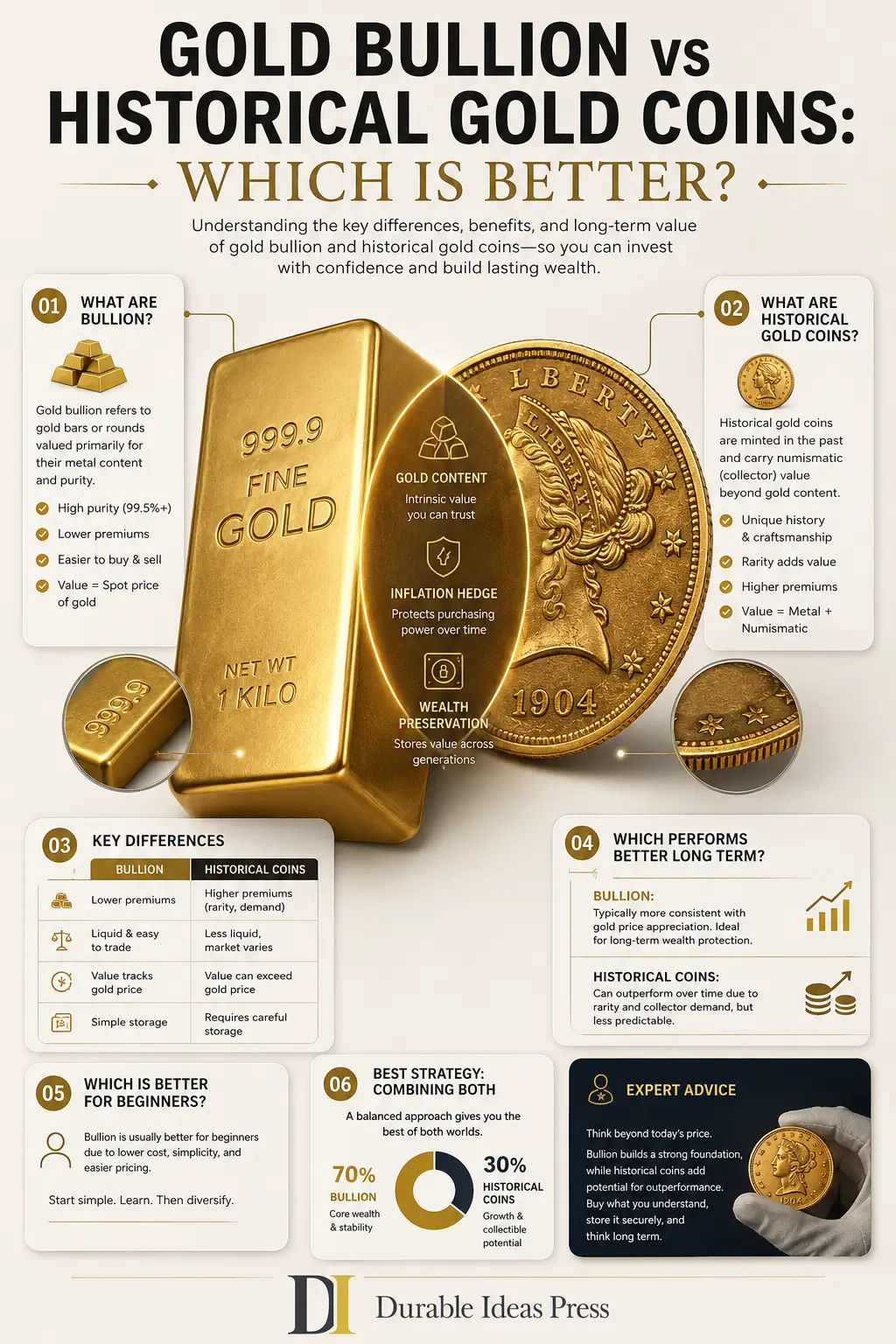
Key Differences
Now that both categories are defined, let’s compare them directly across the four factors that matter most to investors.
Liquidity
Bullion coins win decisively on liquidity. Because they’re produced in huge volumes and valued according to a transparent formula, they can be sold almost anywhere in the world, to almost any dealer, in minutes. Historical coins are far less liquid — selling one typically requires finding a specialist dealer or auction house, and the price you receive can vary significantly depending on who’s buying and how motivated they are. Rare coins in particular may require patience to find the right buyer willing to pay full collector value.
Premiums
Bullion coins carry modest, predictable premiums — typically 3% to 8% above spot for standard sizes. Historical coins carry premiums that are far less predictable and can range enormously: a common-date historical coin might trade close to its melt value, while a rare or perfectly graded specimen can carry a premium of several hundred percent or more above its gold content. This makes historical coins a fundamentally different pricing proposition — you’re not paying primarily for gold, you’re paying for rarity and desirability.
Volatility
Bullion coin prices move in close lockstep with the spot price of gold, making their volatility easy to understand and predict — if gold rises 10%, your bullion holding rises roughly 10% too (minus minor premium fluctuations). Historical coins are subject to two layers of volatility: gold price movements, plus the separate and sometimes unpredictable swings of the collector market, which can be influenced by trends, auction results, and the broader health of the numismatic hobby. This added layer can work in an investor’s favour during a strong collector market, but it can also mean historical coins underperform or stagnate even while gold prices climb.
Collector Value
This is where historical coins have a clear advantage. A rare, well-preserved coin can appreciate based on factors entirely independent of the gold market — a renewed interest in a particular era, a documented rarity becoming better known, or simply long-term scarcity as fewer high-grade examples remain in circulation. Bullion coins, by contrast, have essentially no collector value beyond their gold content (with rare exceptions like low-mintage proof versions), since they’re produced in such large numbers that no individual coin is scarce.
Which Performs Better Long Term?
This is one of the most debated questions in gold investing, and the honest answer is: it depends on what you’re measuring and your time horizon.
Bullion coins perform exactly as gold performs. Over the long run, gold has historically served as a reliable store of value and inflation hedge, generally trending upward over multi-decade periods, even though it can go through extended flat or declining periods along the way. If you buy bullion, your returns are essentially the returns of gold itself, minus the small premium you paid going in (and assuming you don’t pay an excessive premium going out).
For a closer look at the relationship between purchasing power, inflation, and gold, see our guide to gold as an inflation hedge.
Historical coins can outperform bullion significantly — but only specific coins, and only sometimes. High-grade rarities with strong collector demand have, in many documented cases, appreciated well beyond the rate of gold itself over long periods, as scarcity increases and collector interest in certain eras or mint years grows. However, this outperformance is not guaranteed, and it applies unevenly. A common historical coin with no particular rarity may track close to its gold value with a modest collector premium that neither grows nor shrinks much over time. Meanwhile, costs like grading fees, dealer premiums, and the bid-ask spread on resale can eat into numismatic returns more than they would for bullion.
The deciding factor is usually knowledge and selectivity. An investor who deeply understands numismatics — who knows which dates, mint marks, and grades are genuinely scarce, and who buys at fair prices — has a realistic chance of outperforming bullion over the long term. An investor without that expertise is essentially gambling on a market they don’t understand, which is a very different proposition than buying bullion, where the value is transparent regardless of expertise.
If your primary objective is preservation rather than collecting, our guide to gold coins for long-term holding focuses specifically on liquidity, durability, recognition, and multi-decade ownership.
Which Is Better for Beginners?
For the vast majority of beginners, bullion coins are the clear and sensible starting point.
If this is your first purchase, our guide to how to invest in gold coins covers the complete process, from setting a budget to choosing a dealer and storing your coins safely.
The reasoning is straightforward. Bullion coins require no specialist knowledge to buy fairly — you check the spot price, compare premiums across a couple of dealers, and you know immediately whether you’re getting a reasonable deal. There’s no risk of overpaying due to inexperience, no need to learn grading standards, and no danger of being sold an overpriced “rarity” by an unscrupulous dealer preying on inexperience (a surprisingly common scam aimed specifically at beginners).
Historical coins, by contrast, are a specialist field. Without the knowledge to assess rarity, grade, and fair market value, a beginner is at a significant disadvantage when buying numismatic coins — and the financial consequences of a bad purchase can be steep, since premiums on misjudged “rare” coins can be many times the coin’s actual resale value.
This doesn’t mean beginners should never consider historical coins. It simply means the learning curve should come first. Many experienced numismatic collectors started by building a solid bullion position, using that time to read, study graded coin populations, attend coin shows, and gradually develop a feel for the market — before ever committing meaningful money to historical coins. There’s no rush; numismatics is a field best entered with patience and education, not a leap of faith on a first purchase.
Beginners considering collectible coins should also understand the most common gold coin scams, including false rarity claims and altered or counterfeit coins.
Best Strategy: Combining Both
For investors who want the best of both worlds, a hybrid strategy is often the most sensible approach: build a core position in bullion coins, then allocate a smaller portion of your portfolio to historical coins once you’ve developed enough knowledge to do so confidently.
A common framework is to think of bullion as the “foundation” of a gold position — providing transparent, liquid, easily-valued exposure to gold itself — while historical coins serve as a more speculative, satellite allocation, pursued for both potential appreciation and the genuine enjoyment many investors find in numismatics as a hobby alongside an investment.
A reasonable approach for someone interested in eventually adding numismatics might look like this: spend the first year or two building a bullion position exclusively, using that time to study numismatics in parallel — reading reference guides, following auction results, and getting comfortable with grading standards. Once a base of knowledge exists, allocate a modest percentage of new purchases (perhaps 10–20% of ongoing contributions) toward carefully selected, professionally graded historical coins, while continuing to build the bullion core.
This approach captures the predictable, inflation-hedging benefits of bullion while leaving room for the potential outperformance and personal satisfaction that numismatics can offer — without overexposing your portfolio to a market that requires genuine expertise to navigate well.
Final Thoughts + CTA
Bullion and historical gold coins serve different purposes, and neither is universally “better” — the right choice depends on your knowledge, goals, and appetite for complexity. Bullion coins offer transparency, liquidity, and a direct link to gold’s long-term value, making them the right foundation for almost every investor. Historical coins offer the potential for outsized returns and the satisfaction of collecting, but only reward those willing to put in the time to understand the market properly.
If you’re just getting started, the path forward is clear: build your core position in recognised bullion coins first. As your knowledge grows, you can decide whether numismatics deserves a place in your portfolio — and if it does, you’ll be equipped to approach it with the judgment it requires, rather than the guesswork that trips up so many newcomers.
Whichever path you choose, the fundamentals remain the same: buy from reputable sources, understand exactly what you’re paying for, and never let urgency or sales pressure rush a gold purchase. Gold rewards patience — in both the bullion market and the world of historical coins.
Frequently Asked Questions
What is the difference between bullion and numismatic coins?
Bullion coins are valued primarily according to their gold content, priced as the spot price of gold plus a modest premium. Numismatic (historical) coins carry an additional value based on rarity, condition, and collector demand, which means their price can diverge significantly from their underlying gold content — sometimes by a wide margin.
Are historical gold coins a good investment?
They can be, but only for investors who have the knowledge to evaluate rarity, grading, and fair market pricing. Well-chosen historical coins, particularly rare dates in high grades, have in many cases appreciated beyond the rate of gold itself. However, without specialist knowledge, it’s easy to overpay for a coin that doesn’t carry the rarity a buyer assumes it does.
Which is more liquid: bullion or numismatic coins?
Bullion coins are significantly more liquid. They can be sold to virtually any dealer worldwide within minutes, since their value follows a transparent formula tied to the spot price. Numismatic coins typically require a specialist dealer or auction house to achieve a fair price, and the process of selling can take considerably longer.
Do bullion coins or historical coins have lower premiums?
Bullion coins consistently carry lower and more predictable premiums, typically in the range of 3% to 8% above spot price. Historical coin premiums vary enormously — from close to melt value for common, low-grade coins, to several hundred percent above gold content for rare, high-grade specimens.
Should beginners buy bullion or historical coins?
Beginners should generally start with bullion coins. They require no specialist knowledge to buy fairly, and their pricing is transparent and easy to verify against the current spot price. Historical coins are best approached only after building some foundational knowledge of grading, rarity, and the numismatic market.
Can I lose money on numismatic coins even if gold prices rise?
Yes. Because historical coin values are influenced by collector demand as well as gold prices, it’s possible for a numismatic coin to underperform or even decline in value during a period when gold itself is rising, particularly if collector interest in that specific coin or era cools. This added layer of market risk is one of the key reasons numismatics require more expertise than bullion investing.
What does “grading” mean for historical gold coins?
Grading is the process by which a coin’s physical condition is professionally assessed and assigned a standardised score, typically on a 1-to-70 scale used by major grading services like PCGS and NGC. A higher grade generally indicates better preservation and commands a higher price. Graded coins are sealed in tamper-proof holders, which helps establish trust and a verifiable resale value in the secondary market.
Is it better to combine bullion and historical coins in one portfolio?
For many investors, yes. A common approach is to build a core holding in bullion coins for liquidity and transparent gold exposure, then allocate a smaller portion of the portfolio to carefully selected historical coins once sufficient knowledge has been developed. This balances the predictability of bullion with the potential upside and personal enjoyment that numismatics can offer.
Why do some gold coins sell for far more than their gold content?
This happens when a coin has numismatic value beyond its melt value — typically due to rarity, age, historical significance, or exceptional condition. Collectors are willing to pay a premium for these qualities independent of the coin’s gold content, which is why two coins with identical weight and purity can have dramatically different market prices.