
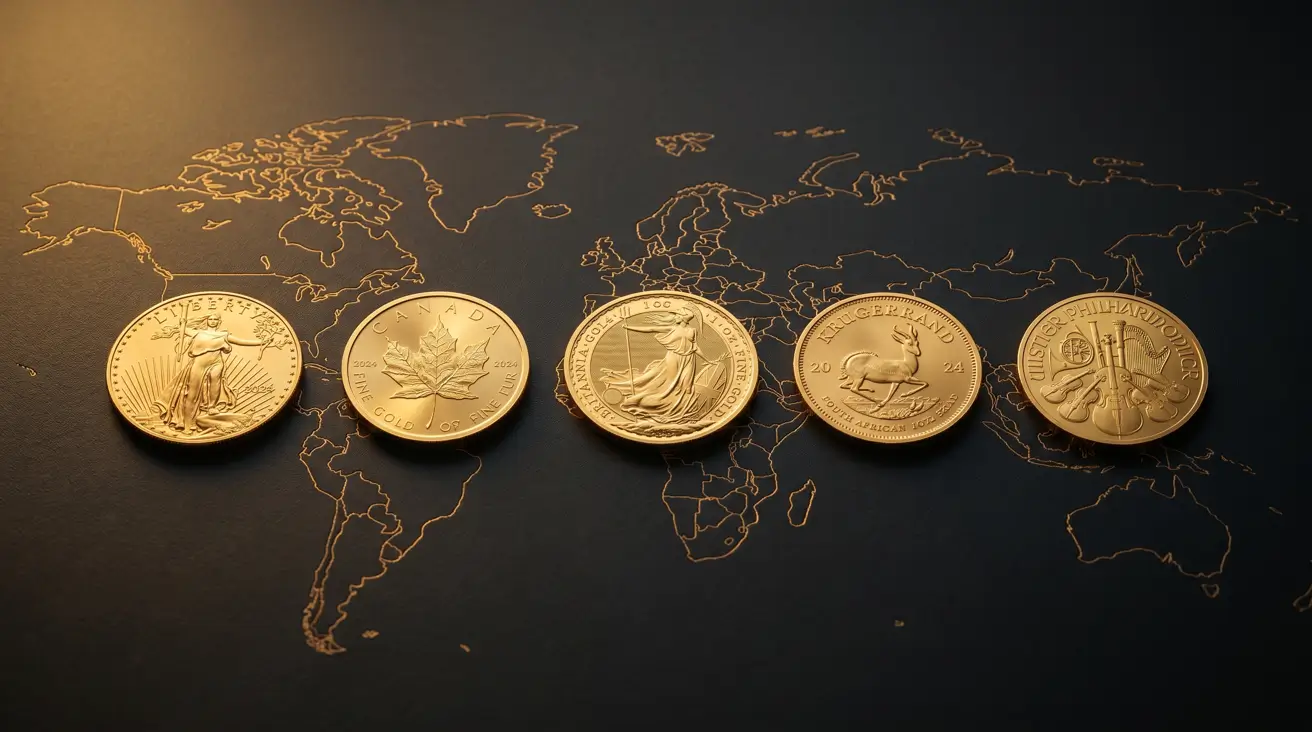
If you’ve decided to invest in physical gold, the next question is which coin to actually buy. Walk into the bullion market and you’ll find dozens of options, each with its own purity, design, mint history, and price premium. Some are better suited to beginners, others to serious long-term holders, and a few are best left to dedicated collectors.
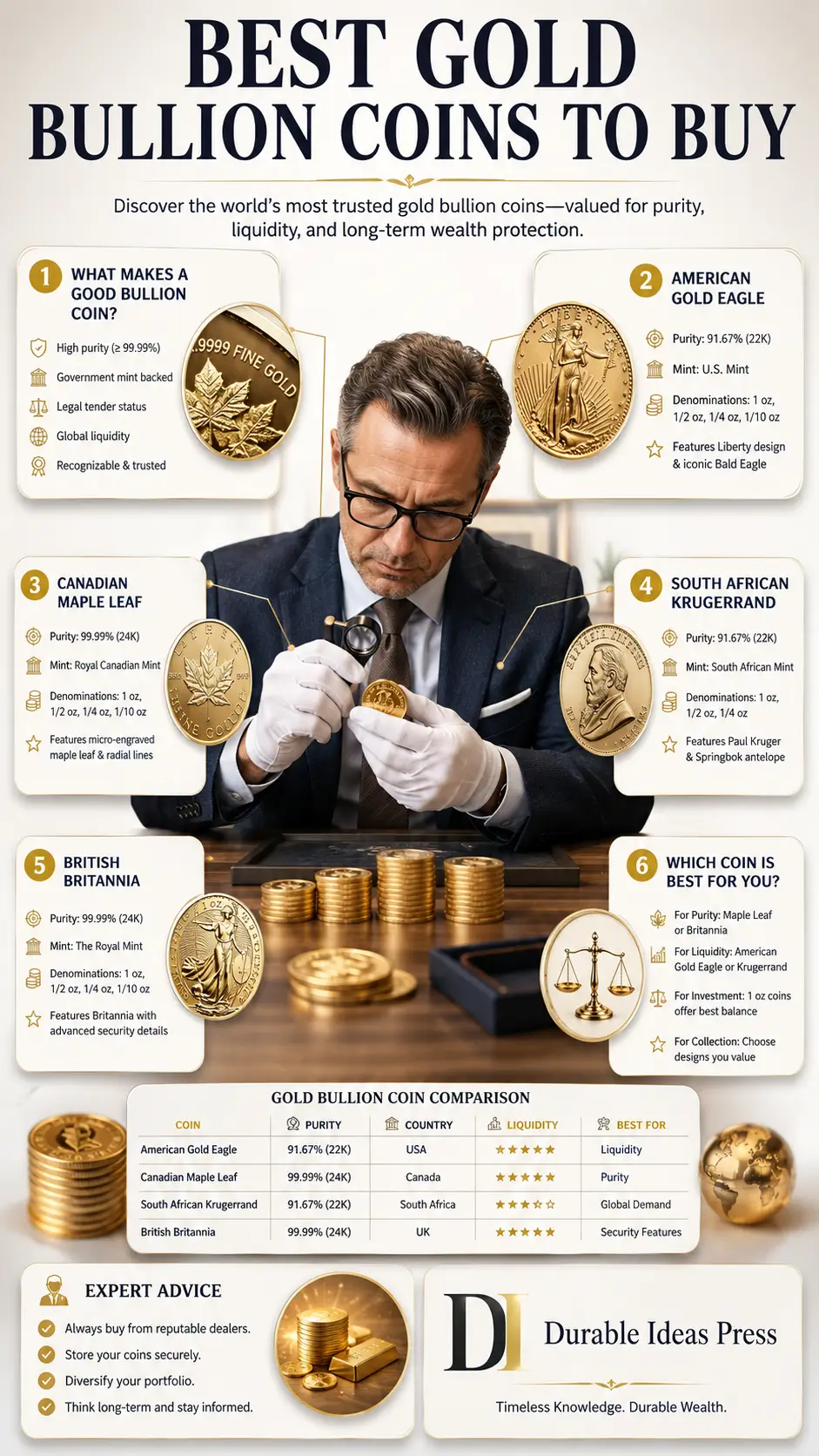
This guide breaks down the best gold bullion coins to buy in 2026, comparing the four most widely traded options in the world: the American Gold Eagle, the Canadian Maple Leaf, the South African Krugerrand, and the British Britannia. You’ll learn what separates a genuinely good bullion coin from an average one, how each of the top coins stacks up, and which one is the right fit depending on your goals and budget.
By the end, you’ll be equipped to make a confident, informed purchase — whether you’re buying your first coin or expanding an existing holding.
Prefer to listen?
This article is also available as a podcast episode.
Listen to this episode on Spotify
What Makes a Good Bullion Coin?
Not every gold coin on the market deserves a place in a serious investment portfolio. Before comparing specific coins, it helps to understand the four characteristics that separate the best bullion coins from the rest.
Liquidity
Liquidity refers to how easily a coin can be bought and sold at a fair price, anywhere in the world. The best gold bullion coins are accepted by dealers, banks, and private buyers across virtually every country, with minimal friction. A coin with poor liquidity might be difficult to offload quickly, or might only fetch a fair price from a narrow pool of specialist buyers. The top-tier coins covered in this guide are all highly liquid, traded in massive volumes daily on the global bullion market.
Premiums
The premium is the amount you pay above the coin’s gold content (spot value), covering minting, distribution, and dealer margin. Lower premiums mean more of your money goes directly into gold ownership rather than overhead costs. Premiums vary by coin, by size, and by current market demand — but the most established coins tend to carry the most competitive premiums, since they’re produced at scale and traded in high volumes.
Recognition
A coin’s global recognition directly affects how easily it can be resold and how confidently a buyer will purchase it without extensive verification. Coins backed by national mints — and produced consistently for decades — earn a level of trust that newer or regional coins simply haven’t built yet. This recognition also means dealers worldwide can quote a price on the spot, without needing to authenticate or research the coin first.
Purity
Purity refers to the percentage of actual gold content in a coin, measured in karats or as a fineness percentage (such as .9999 fine, meaning 99.99% pure gold). Higher purity coins are softer and more prone to scratching, so some mints intentionally alloy their coins with small amounts of other metals for durability. Neither approach is inherently better — it depends on whether you prioritise maximum gold content or a more durable coin — but understanding a coin’s purity is essential for comparing true value.
With these four criteria established, let’s look at how the leading bullion coins measure up.
Get our free 2026 Gold Investment Starter Pack here
American Gold Eagle
History
First issued by the United States Mint in 1986, the American Gold Eagle was created in response to growing public demand for a US government-backed gold bullion coin. It quickly became one of the most popular bullion products in the world and remains a flagship product of the US Mint to this day. The coin’s design — Lady Liberty striding forward on the obverse, and a family of eagles on the reverse — is one of the most recognisable in the bullion world.
Liquidity
The American Gold Eagle is exceptionally liquid, particularly within the United States, where it’s the most widely held and traded gold bullion coin. It’s also broadly accepted internationally, and most reputable dealers worldwide will buy and sell it without hesitation.
Pros and Cons
The Eagle’s main advantage is its sheer recognition and trust — it’s backed by the full faith of the US government for weight and purity, which gives buyers confidence. Its alloy composition (91.67% gold, with silver and copper added) makes it notably more scratch- and dent-resistant than purer coins, which matters for long-term physical handling and storage.
The trade-off is purity. At 22-karat (91.67% fine), the Eagle contains less actual gold per coin than competitors like the Maple Leaf or Britannia, which means you’re paying for a coin with proportionally less pure gold content, even though total weight is the same. Premiums on the Eagle also tend to run slightly higher than some competitors, reflecting strong brand demand.
Canadian Maple Leaf
Purity
The Canadian Maple Leaf, minted by the Royal Canadian Mint since 1979, is renowned for its exceptional purity — 99.99% fine gold (24-karat), among the highest of any major bullion coin in the world. For investors who prioritise maximum gold content per coin, the Maple Leaf is one of the strongest options available.
Security Features
The Royal Canadian Mint has invested heavily in anti-counterfeiting technology for the Maple Leaf. Since 2013, coins have included a Bullion DNA system: a micro-engraved security mark visible only under magnification, paired with a unique digital fingerprint that can be verified using a special handheld device. This makes the Maple Leaf one of the most difficult bullion coins to convincingly counterfeit, adding a layer of buyer confidence that’s particularly valuable in the secondary market.
The coin’s design has also evolved over the decades, with radial security lines added to the surface as a further anti-counterfeit measure, visible as a textured pattern when the coin catches the light at certain angles.
Overall Assessment
The Maple Leaf combines exceptional purity with genuinely industry-leading security technology, making it a favourite among investors who want both maximum gold content and strong protection against counterfeiting. Its main drawback is that, due to its high purity, it’s a softer coin than alloyed alternatives like the Eagle or Krugerrand, making it somewhat more susceptible to surface scratches with repeated handling.
Security features help, but they are only one part of buying authentic gold coins safely, especially on the secondary market.
South African Krugerrand
Global Recognition
Introduced in 1967, the Krugerrand holds the distinction of being the world’s first modern gold bullion coin, designed specifically to make gold ownership accessible to everyday investors rather than only central banks. For decades, it dominated the global bullion market, and at one point accounted for the vast majority of all gold coins traded worldwide. That long history has cemented its recognition — dealers and investors everywhere know the coin on sight, and it remains one of the most traded bullion coins on the planet today.
Lower Premiums
One of the Krugerrand’s most attractive features for investors is its consistently competitive premium. Because it’s produced in enormous volumes and has been a market staple for nearly six decades, dealer premiums on the Krugerrand tend to be among the lowest of any major bullion coin. For investors focused on maximising gold ownership per dollar spent, this makes the Krugerrand a particularly efficient choice.
Like the American Gold Eagle, the Krugerrand is alloyed with copper, giving it 91.67% gold purity (22-karat) and a notably durable, scratch-resistant surface — a deliberate design choice from its original introduction, intended to withstand decades of handling and circulation.
Overall Assessment
The Krugerrand’s combination of historical pedigree, universal recognition, and low premiums makes it an excellent value-focused choice for investors who want maximum gold exposure per unit of currency spent, without sacrificing liquidity or trust.
British Britannia
Anti-Counterfeit Technology
The British Britannia, issued by the Royal Mint, has become one of the most secure bullion coins available, thanks to a suite of advanced anti-counterfeiting measures introduced over the past decade. These include high-relief surface detailing, a tincture line system embedded within the design (which uses subtle engraved lines to indicate colour ranges, invisible to counterfeiters without specialised knowledge), and surface animation features that create a subtle, shifting visual effect when the coin is tilted under light.
Since 2013, the Britannia has been struck in 99.99% fine gold, matching the purity of the Canadian Maple Leaf and placing it among the purest mainstream bullion coins available. The combination of high purity and cutting-edge security technology makes counterfeiting the Britannia exceptionally difficult.
Tax Advantage for UK Investors
Beyond its security features, the Britannia carries a unique benefit for UK-based investors: as legal tender within the United Kingdom, it is exempt from Capital Gains Tax. This makes it one of the most tax-efficient ways for UK residents to invest in physical gold, and a major reason it’s become the preferred bullion coin for many British investors specifically.
Overall Assessment
The Britannia stands out for combining top-tier purity with some of the most sophisticated anti-counterfeit technology in the bullion market, plus a meaningful tax advantage for UK buyers. Its main limitation is that, outside the UK and Europe, it’s slightly less universally recognised than the Eagle or Krugerrand, though this gap has narrowed significantly as the coin’s international trading volume has grown.
Which Bullion Coin Is Best for You?
There’s no single “best” bullion coin — the right choice depends on your goals, budget, and experience level. Here’s how the four leading coins map onto different types of investors.
For Beginners
The Canadian Maple Leaf or British Britannia are the strongest starting points. Both offer maximum purity (99.99% fine gold), making their value easy to calculate and compare, and both come from mints with excellent reputations and strong anti-counterfeit protections. Their straightforward value proposition makes them easy to understand without prior bullion experience.
If you’re still learning the buying process itself, our beginner guide to gold coins covers budgeting, dealers, premiums, storage, and your first purchase step by step.
For Collectors
While this guide focuses on bullion rather than numismatic coins, collectors gravitating toward bullion will often appreciate the American Gold Eagle for its rich design history and the cultural significance of being the US Mint’s flagship gold product. Annual design variations and proof versions also give collectors more to pursue than the more uniform designs of some competitors.
If you’re deciding whether collectible coins belong in your strategy, compare historical gold coins and bullion before moving beyond investment-grade bullion.
For Low Budget Investors
The South African Krugerrand is the standout choice for budget-conscious buyers. Its consistently low premiums mean more of your money buys actual gold rather than covering minting and distribution costs. Fractional sizes are also widely available, allowing entry at a lower price point.
Investors working with a modest budget may also want to compare fractional gold coins for small investors, including 1/10 oz and 1/4 oz options.
For Long-Term Investors
Long-term holders benefit most from coins that combine high liquidity with strong resale value decades down the line. The Krugerrand’s six-decade trading history and the Eagle’s deep liquidity within the world’s largest economy both make them excellent long-haul holdings. The Maple Leaf and Britannia, with their superior purity and modern security features, are equally strong choices for investors planning to hold for the very long term, including passing gold down to future generations.
If your primary objective is to protect wealth from inflation, our dedicated guide explains how gold can function as a long-term portfolio hedge.
If your priority is holding gold across decades rather than simply choosing the best all-around bullion product, see our guide to gold coins for long-term wealth preservation.
Final Recommendation
If forced to choose a single best all-around bullion coin, the Canadian Maple Leaf edges ahead for most investors. It combines maximum purity, industry-leading anti-counterfeit technology, strong global liquidity, and competitive premiums — a well-rounded package that suits beginners and experienced investors alike.
That said, the right answer genuinely depends on your priorities. If minimising premiums is your main goal, the Krugerrand is hard to beat. If you’re a UK resident focused on tax efficiency, the Britannia’s CGT exemption makes it the clear winner. And if you simply want the most universally recognised coin in the largest gold market in the world, the American Gold Eagle remains an excellent, dependable choice.
The good news is that all four coins discussed in this guide are considered top-tier, safe options. You won’t go wrong with any of them — the differences are about optimising for your specific situation, not avoiding a bad purchase.
Final Thoughts + Your Gold Coin Buying Checklist
Choosing the right bullion coin doesn’t need to be complicated once you understand the key factors: liquidity, premiums, recognition, and purity. The four coins covered here — the American Gold Eagle, Canadian Maple Leaf, South African Krugerrand, and British Britannia — represent the safest, most established options in the global gold market, each with its own strengths depending on your goals.
Before making your purchase, run through this checklist:
Gold Coin Buying Checklist
- [ ] I’ve identified which factor matters most to me (purity, premium, recognition, or liquidity)
- [ ] I’ve compared current premiums across at least two reputable dealers
- [ ] I understand the purity level of the coin I’m buying and what it means for value
- [ ] I’ve confirmed the coin is from a major, internationally recognised mint
- [ ] I’ve checked whether the coin has anti-counterfeit features I should verify
- [ ] I’ve considered my budget and whether a fractional size makes sense
- [ ] I’ve thought about my time horizon — short-term flexibility vs long-term holding
- [ ] I have a secure storage plan ready before the coin arrives
Once you’ve worked through these points, you’ll be in a strong position to buy with confidence. Whether you choose the purity of the Maple Leaf, the value of the Krugerrand, the tax efficiency of the Britannia, or the trusted legacy of the American Gold Eagle, you’re choosing a coin that has stood the test of time in the global bullion market.
Frequently Asked Questions
What is the best gold bullion coin to buy overall?
There’s no universal answer, since the “best” coin depends on your priorities. The Canadian Maple Leaf is often considered the best all-around choice thanks to its 99.99% purity and advanced anti-counterfeit technology, but the American Gold Eagle, South African Krugerrand, and British Britannia are all excellent, safe alternatives with their own distinct advantages.
What are the safest gold coins to buy?
The safest gold coins are those produced by established national mints with long track records, strong anti-counterfeit technology, and deep liquidity. The American Gold Eagle, Canadian Maple Leaf, South African Krugerrand, and British Britannia are widely regarded as the four safest bullion coins available, since all are backed by government mints and traded in enormous volumes worldwide.
Which gold coin has the lowest premium?
The South African Krugerrand typically carries the lowest premiums of any major bullion coin, largely due to its enormous trading volume and nearly 60-year production history. Premiums fluctuate with market demand, so it’s always worth comparing current pricing across a few dealers before buying.
Which gold coin has the highest purity?
The Canadian Maple Leaf and British Britannia both contain 99.99% fine gold, making them the purest of the four major bullion coins covered in this guide. The American Gold Eagle and South African Krugerrand are both 91.67% fine gold (22-karat), alloyed with other metals for added durability.
Is the American Gold Eagle a good investment?
Yes. The American Gold Eagle is one of the most liquid and widely recognised bullion coins in the world, backed by the US government for weight and purity. Its slightly lower gold content compared to 24-karat coins is offset by its superior durability and unmatched liquidity within the US market, making it a strong choice for American investors in particular.
Are gold coins better than gold bars for beginners?
For most beginners, coins are generally easier to buy, sell, and verify than bars, particularly in smaller denominations. Coins from major mints also benefit from advanced anti-counterfeit features that aren’t always available on bars. Bars can offer slightly lower premiums for larger gold purchases, but coins tend to offer better flexibility and liquidity for everyday investors.
How do I know which bullion coin is right for my budget?
Start by considering the price of a 1 oz coin in your target option, then check if fractional sizes (1/2 oz, 1/4 oz, 1/10 oz) are available if your budget is more limited. The Krugerrand and Eagle are widely available in fractional sizes at competitive premiums, making them accessible starting points for smaller budgets.
Do all these coins count as legal tender?
Yes, all four coins discussed in this guide — the American Gold Eagle, Canadian Maple Leaf, South African Krugerrand, and British Britannia — are legal tender in their country of origin, with a nominal face value. However, their actual market value is determined by their gold content and demand, which is far higher than the printed face value.
Can I mix different bullion coins in my portfolio?
Absolutely. Many experienced investors hold a mix of coins to balance different priorities — for example, combining the low premiums of the Krugerrand with the high purity of the Maple Leaf. Diversifying across a few well-recognised coins doesn’t add meaningful risk, since all are highly liquid and easy to value individually.