

Gold has been a store of wealth for thousands of years, and today it remains one of the most sought-after assets for investors looking to protect and grow their money. But if you’ve never purchased gold before, knowing where to start can feel overwhelming. What type of gold should you buy? How much do you need? Where do you find a trustworthy dealer?
This guide answers all of those questions. Whether you’re a complete beginner with a modest budget or someone ready to make a more significant commitment, gold coin investing is one of the most accessible ways to own physical gold. By the end of this article, you’ll understand the different types of gold coins available, which ones are best suited for new investors, how to avoid the most common mistakes, and exactly where to buy with confidence.
Let’s get started.
Prefer to listen?
This article is also available as a podcast episode.
Listen to this episode on Spotify
Why Investors Buy Gold Coins
Before diving into the how, it’s worth understanding the why. Gold coins aren’t just collectibles — they’re a serious financial instrument used by millions of investors worldwide. Here are the main reasons people add gold coins to their portfolios.
Inflation Protection
Inflation erodes the purchasing power of paper money over time. When central banks print more currency, each unit buys less. Gold, on the other hand, has maintained its purchasing power across centuries. An ounce of gold that bought a fine Roman toga in 50 BC can still buy a quality suit today. When inflation rises, the price of gold often rises with it, making it one of the most reliable inflation hedges available.
For a deeper look at how this works in practice, see our guide to using gold as an inflation hedge.
Wealth Preservation
Gold coins don’t pay dividends, and they don’t generate interest — but they don’t disappear either. Unlike stocks, which can go to zero, or bonds, which can default, gold retains intrinsic value. This makes it a preferred asset for wealth preservation, especially across generations. Many families pass gold coins down as a form of long-term savings that transcends economic cycles.
For investors thinking beyond their first purchase, our guide to preserving wealth with gold examines which coins are best suited to multi-decade holding.
Safe Haven Asset
During periods of geopolitical uncertainty, financial crises, or market volatility, investors tend to flock to gold. Its price often rises when equity markets fall. This inverse correlation makes gold coins a powerful diversification tool. Adding even a small allocation — commonly 5% to 10% of a portfolio — can reduce overall risk without sacrificing long-term returns.
Tangible Ownership
There’s something uniquely reassuring about holding a physical asset. Unlike digital investments or paper certificates, gold coins are real. They can be held in your hand, stored in a safe, and accessed without a brokerage account or internet connection. For investors who are concerned about counterparty risk — the possibility that a financial institution might fail — physical gold eliminates that variable entirely.
Get our free 2026 Gold Investment Starter Pack here
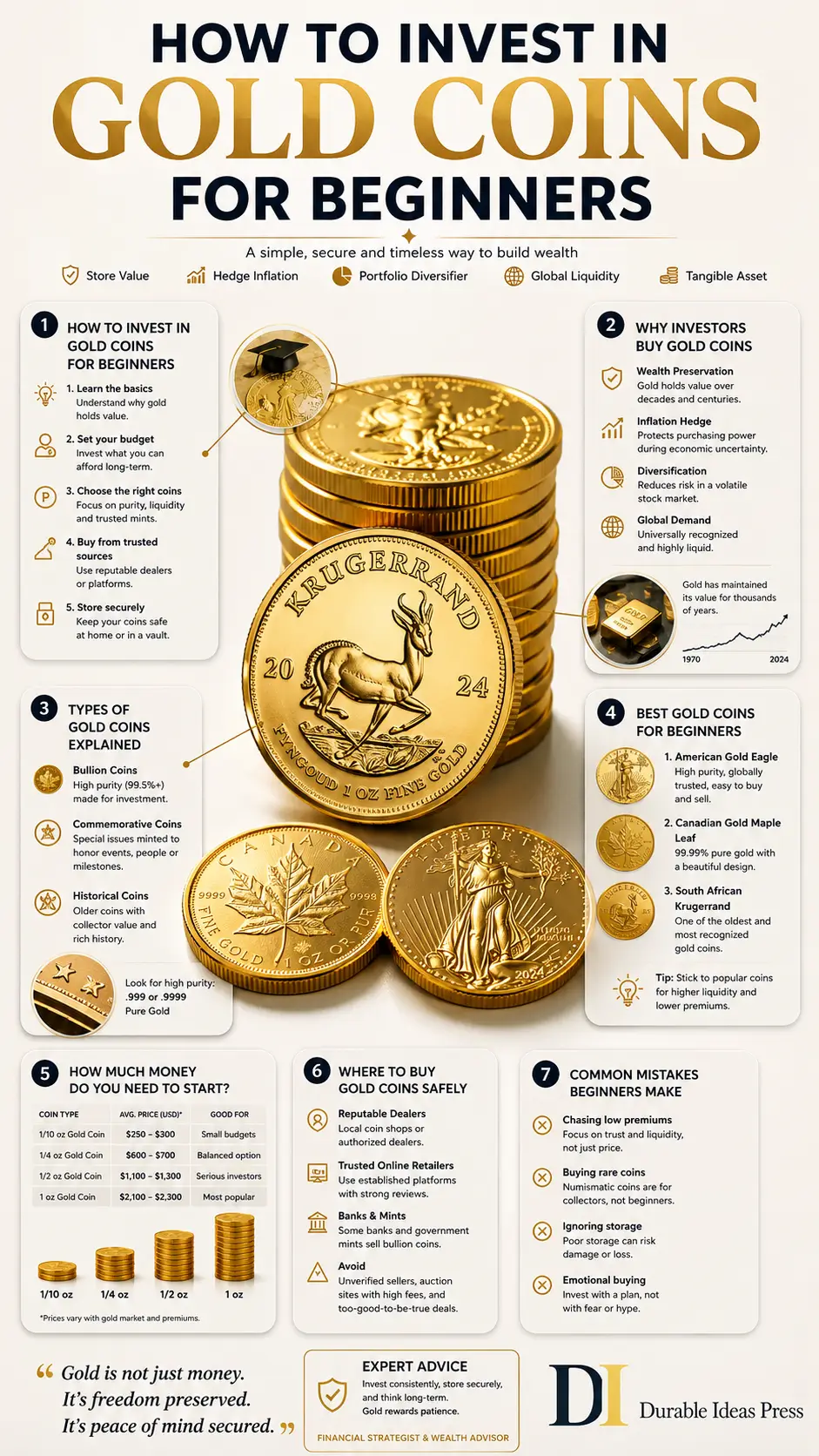
Types of Gold Coins Explained
Not all gold coins are created equal. Before you buy, you need to understand the three main categories and what distinguishes them.
Bullion Coins
Bullion coins are minted primarily for investment purposes. Their value is tied directly to the spot price of gold — the current market price per troy ounce — plus a small premium that covers minting and distribution costs. They’re produced in standardised weights (most commonly 1 oz, 1/2 oz, 1/4 oz, and 1/10 oz) and carry a face value, though their actual market value far exceeds it.
Examples include the American Gold Eagle, the Canadian Maple Leaf, and the South African Krugerrand. These are the coins most beginners should focus on. They’re easy to buy, easy to sell, and universally recognised. Premiums are typically modest — anywhere from 3% to 8% above spot price for standard sizes.
Pros: Highly liquid, globally recognised, straightforward pricing, easy to resell.
Cons: No numismatic premium, modest aesthetic appeal for collectors.
Historical (Numismatic) Coins
Historical coins are older coins — often pre-1933 in the US context — that carry both a gold content value and a collector’s premium based on rarity, condition, and historical significance. A well-preserved Double Eagle from the early 20th century, for example, might be worth many times its gold content alone.
Pros: Potential for significant appreciation if the coin is rare and desirable.
Cons: Difficult to value accurately, requires specialist knowledge, premiums can be enormous, resale depends on finding the right buyer.
Commemorative Coins
Commemorative coins are special issues produced to mark events, anniversaries, or figures of cultural significance. Some are legal tender; many are not. They’re often sold with heavy premiums driven by marketing rather than intrinsic value.
Pros: Visually distinctive, can make meaningful gifts.
Cons: High premiums, poor liquidity, not ideal as investments.
The Verdict for Beginners
Unless you have a deep interest in numismatics and the knowledge to back it up, beginners should stick to bullion coins. They’re transparent, liquid, and their value is easy to track. Leave historical and commemorative coins until you have more experience.
If you want to understand the trade-offs in more detail, see our comparison of bullion vs numismatic coins.
Best Gold Coins for Beginners
With so many bullion coins on the market, which ones should a beginner choose? Here are the four most widely recommended options.
Canadian Maple Leaf
Issued by the Royal Canadian Mint since 1979, the Maple Leaf is one of the purest gold coins in the world, containing 99.99% fine gold. It’s recognised across the globe and consistently one of the best-selling bullion coins year after year. The coin features the iconic maple leaf on the reverse and a portrait of the monarch on the obverse. Premiums are competitive, and resale is straightforward in virtually any country. It’s an excellent first choice.
British Britannia
The Britannia is issued by the Royal Mint and has been updated to contain 99.99% fine gold since 2013. It benefits from a key advantage for UK investors: it is legal tender in the United Kingdom, which means it is exempt from Capital Gains Tax (CGT). This makes it particularly attractive for British investors, but its global recognition also makes it a solid choice elsewhere. The design — featuring the iconic figure of Britannia — is one of the most celebrated in the world of bullion.
American Gold Eagle
The Eagle is arguably the most recognised gold coin in the world. Issued by the United States Mint since 1986, it contains 91.67% gold (the balance is silver and copper, which adds durability). It’s backed by the US government for weight and gold content, and it enjoys enormous liquidity in both domestic and international markets. The only minor drawback is that its purity is slightly lower than the Maple Leaf or Britannia, though this rarely affects investment performance.
South African Krugerrand
The Krugerrand was the world’s first modern gold bullion coin, introduced in 1967. For decades it was the dominant coin in the global gold market, and it remains highly liquid today. Like the Eagle, it’s 91.67% gold. Its historical significance makes it instantly recognisable, and premiums tend to be among the lowest of any bullion coin. Beginners who are budget-conscious will often find the Krugerrand offers the best value per gram of gold.
For a deeper side-by-side comparison of these options, see our guide to the best gold bullion coins.
How Much Money Do You Need to Start?
One of the most common misconceptions about gold investing is that it requires significant capital. It doesn’t.
Starting with Fractional Gold Coins
Standard bullion coins come in 1-troy-ounce size, which, at current gold prices, costs well over a thousand pounds or dollars. But most major mints also produce fractional coins — 1/2 oz, 1/4 oz, and 1/10 oz sizes. A 1/10 oz coin offers genuine physical gold ownership for a few hundred pounds or dollars, making it accessible to almost anyone.
The trade-off is that fractional coins carry higher premiums as a percentage of gold content. Where a 1 oz coin might carry a 4% premium, a 1/10 oz version of the same coin might carry a 10–12% premium. This is simply the cost of smaller production runs and the per-coin minting costs being spread over less gold. It’s still worth it for beginners who want to start small.
If you’re starting with a smaller budget, our guide to the best fractional gold coins compares the strongest 1/10 oz and 1/4 oz options in detail.
Dollar-Cost Averaging
Rather than trying to time the market, many gold investors use dollar-cost averaging — buying a fixed amount on a regular schedule regardless of the current price. For example, purchasing one 1/10 oz coin every month means you buy more gold when prices are low and less when they’re high, smoothing out your average cost over time.
This approach removes the psychological pressure of trying to “buy the dip” and builds a meaningful position gradually. It’s also far more sustainable for most budgets than making a single large purchase.
Setting a Realistic Budget
A reasonable starting point for a complete beginner is $150–$1,200 or the equivalent in your currency. This is enough to purchase one or two fractional coins from a reputable dealer, give you real experience with the buying process, and start building a tangible holding without overcommitting. From there, you can scale up as your confidence and understanding grow.
Where to Buy Gold Coins Safely
Knowing where to buy is just as important as knowing what to buy. The gold market has legitimate, reputable dealers — but it also has its share of scammers.
Established Bullion Dealers
The most reliable route for beginners is to purchase from established, accredited bullion dealers. In the UK, look for members of the British Numismatic Trade Association (BNTA) or dealers accredited by the London Bullion Market Association (LBMA). In the US, seek out members of the Professional Numismatists Guild (PNG) or the Industry Council for Tangible Assets (ICTA).
Reputable dealers include names like The Royal Mint (UK), APMEX (US), JM Bullion (US), and BullionVault. These companies have been operating for years or decades, carry extensive inventories, publish transparent pricing, and provide certificates of authenticity.
Online Stores
Buying online is now the most common way to purchase bullion coins. The advantages are convenience, competitive pricing, and a wide range of products. Reputable online dealers display live pricing tied to the spot market, clearly show total premiums, and offer insured shipping.
When buying online, always verify that the website uses secure payment processing (look for HTTPS and recognisable payment options), check independent reviews, and avoid sellers offering prices dramatically below the spot price — this is invariably a scam.
Verifying Authenticity
Counterfeit gold coins exist, though they’re more common at flea markets and informal sales than through established dealers. When buying from a trusted source, authentication is less of a concern. However, if you ever purchase from a private seller or an unfamiliar source, a few basic checks are worthwhile: weigh the coin (gold has a precise density), measure its dimensions, and consider investing in a basic gold testing kit or an electronic verifier.
Avoiding Scams
The most common scams targeting beginners include:
- Too-good-to-be-true pricing — genuine gold cannot be sold significantly below spot price. If someone is offering it, the coin is either fake or the deal has hidden strings.
- High-pressure sales — legitimate dealers never rush you into a purchase. Anyone urging you to “act now” is a red flag.
- Unverified private sellers — buying from strangers on social media or classified ad sites is high risk without physical inspection and verification.
- Collectible upselling — some less scrupulous dealers push commemorative or numismatic coins on beginners, claiming they’ll appreciate dramatically. They rarely do, and the premiums are often enormous.
For a complete checklist of tests and warning signs, see our guide on how to identify fake gold before making a purchase.
Common Mistakes Beginners Make
Even well-intentioned beginners make avoidable errors. Here are the most common — and how to sidestep them.
Buying Collectibles Too Early
It’s tempting to be drawn in by beautiful, historically significant coins. But numismatic investing is a specialist field that requires deep knowledge of grading, market trends, and rarity. A beginner who buys a “rare” coin based on a dealer’s recommendation often pays a massive premium for something that’s far harder to resell. Stick to standard bullion until you understand the market thoroughly.
Overpaying on Premiums
Premiums vary significantly between dealers and between coin types. A beginner who doesn’t shop around might pay 15% above spot when another dealer is charging 5% for the same coin. Always compare at least two or three sources before buying. Also be wary of coins bundled with expensive packaging, certificates, or “limited edition” designations that inflate the price without adding real value.
Ignoring Liquidity
Not all gold coins are equally easy to sell. Obscure national mint products, unusual sizes, or heavily damaged coins can sit unsold for a long time. When buying, always ask yourself: if I needed to sell this quickly, could I? Standard bullion coins from major mints — Eagles, Maple Leafs, Britannias, Krugerrands — have the deepest buyer pools and are easiest to liquidate at fair prices.
Neglecting Storage and Insurance
Physical gold needs to be stored securely. Keeping coins in a sock drawer is not a strategy. Options include a home safe (ideally bolted down), a bank safety deposit box, or allocated storage through a specialist vault service. Whatever you choose, factor in the cost and make sure your coins are covered by insurance. Some home insurance policies cover precious metals; others don’t — check your policy before assuming.
Failing to Track Your Cost Basis
For tax purposes, you need to know exactly what you paid for each coin, including premiums and any transaction fees. Keep records from day one. In many jurisdictions, profit from selling gold coins is subject to Capital Gains Tax (though UK investors in Britannias have an exception, as noted above). Sloppy record-keeping can create real headaches if you ever sell a substantial holding.
Final Thoughts + Your Gold Coin Buying Checklist
Gold coin investing is not complicated, but like any investment, it rewards those who do their homework. The fundamentals are straightforward: buy reputable bullion coins from trustworthy dealers, start with a budget you’re comfortable with, build your position gradually, and store your coins securely.
Here’s a simple checklist to use before making your first purchase:
Gold Coin Buying Checklist
- [ ] I have decided on a starting budget I’m comfortable committing
- [ ] I’ve chosen a reputable, accredited bullion dealer
- [ ] I’ve compared premiums across at least two dealers
- [ ] I’m buying a recognised bullion coin (Maple Leaf, Britannia, Eagle, or Krugerrand)
- [ ] I understand the current spot price of gold and the total premium I’m paying
- [ ] I have a secure storage plan in place
- [ ] I’ve checked whether my home insurance covers precious metals
- [ ] I’ve recorded my purchase price and date for tax purposes
If you can tick every box on that list, you’re ready to make a smart first purchase.
Gold won’t make you rich overnight, but it’s one of the most time-tested ways to protect and preserve wealth over the long term. Whether you’re hedging against inflation, diversifying a stock-heavy portfolio, or simply beginning to build a tangible financial foundation, gold coins are an excellent place to start.
Frequently Asked Questions
What is the best gold coin for a beginner?
For most beginners, the Canadian Maple Leaf or the British Britannia are the top choices. Both are 99.99% pure gold, globally recognised, and carry competitive premiums. UK investors gain an additional advantage with the Britannia due to its Capital Gains Tax exemption. The American Gold Eagle and South African Krugerrand are also excellent options with strong liquidity worldwide.
How much does a gold coin cost?
The price depends on the gold spot price at the time of purchase, plus the dealer’s premium. A standard 1 oz gold coin typically costs the spot price plus 3–8%, which at current prices puts most coins in the range of $2,200–$3,000 (prices vary with the market). Fractional coins such as 1/10 oz are available for a few hundred pounds or dollars, though with higher percentage premiums.
Is it safe to buy gold coins online?
Yes, provided you buy from an established, accredited dealer with a track record and transparent pricing. Reputable online dealers use secure payment systems, provide certificates of authenticity, and ship via insured, tracked services. Avoid purchasing from unknown private sellers, social media marketplaces, or any source offering gold at prices significantly below spot value.
Do I pay tax on gold coins?
Tax treatment varies by country. In the UK, gold coins that are legal tender (such as Britannias and Sovereigns) are exempt from Capital Gains Tax. In the US, gold coins are typically subject to CGT as collectibles, with a maximum rate of 28%. In most countries, there is no VAT or sales tax on investment-grade gold bullion. Always consult a tax adviser for guidance specific to your situation.
What is a “premium” on a gold coin?
A premium is the amount you pay above the gold spot price. It covers the costs of minting, distribution, and the dealer’s margin. A coin selling at a 5% premium over a $2,000 spot price would cost $2,100. Premiums vary by coin type, size, and dealer — comparing premiums before you buy can save meaningful money, especially on larger purchases.
How should I store gold coins at home?
A quality home safe that is bolted to the floor or concealed within the structure of the building is the most practical solution for modest holdings. Ensure the safe is fire-resistant as well as theft-resistant. For larger holdings, consider a specialist vault service that offers allocated storage with full insurance. Avoid keeping coins in obvious or easily accessible locations, and do not advertise your ownership to others.
What is the difference between bullion and numismatic coins?
Bullion coins derive their value primarily from their gold content. Numismatic (or collectible) coins carry an additional premium based on rarity, historical significance, and condition. Beginners should focus on bullion coins, which are easier to value, more liquid, and require no specialist knowledge to buy and sell fairly.
Can I invest in gold coins with a small budget?
Absolutely. Fractional gold coins — available in 1/2 oz, 1/4 oz, and 1/10 oz sizes — allow you to own real, physical gold for a few hundred pounds or dollars. While the percentage premiums are slightly higher on smaller coins, they remain a sound way to start building a gold position without a large upfront commitment. Using a dollar-cost averaging approach, buying small amounts regularly, is a particularly effective strategy on a limited budget.
How do I know if a gold coin is genuine?
When buying from a reputable dealer, authenticity is rarely a concern — established mints and accredited dealers stand behind the coins they sell. If you ever purchase from a secondary source, verify the coin’s weight and dimensions against official specifications, use a gold testing kit, or have it assessed by a reputable dealer. Coins from major mints (Royal Canadian Mint, US Mint, Royal Mint UK) are among the most difficult to counterfeit convincingly.
When is the best time to buy gold?
Timing the gold market is notoriously difficult, even for professional investors. A more reliable approach is dollar-cost averaging — investing a consistent amount at regular intervals regardless of price. This removes the pressure of trying to buy at the “perfect” moment and builds a position at an averaged cost over time. Focus on your long-term goals rather than short-term price movements.