

Most investment decisions are made with a time horizon of months or years. Wealth preservation is a different kind of challenge entirely — it’s about protecting the real value of what you’ve built across decades, through economic cycles, political changes, currency devaluations, and the unpredictable events that no financial model anticipates. It’s the difference between asking “how do I grow my money this year?” and asking “how do I ensure my family’s financial foundation remains intact twenty years from now?”
Gold has served this second purpose longer than any other asset in recorded history. Not because it always outperforms equities, or because it generates income, but because it has consistently held its purchasing power across time in a way that no paper currency ever has. For investors focused on long-term wealth preservation — whether for retirement, intergenerational transfer, or simply the protection of hard-earned savings — gold coins remain one of the most reliable tools available.
This guide focuses specifically on which gold coins are best suited to long-term holding, why gold’s relationship with fiat currency makes it a rational foundation for any preservation strategy, how gold has performed through major historical crises, and how to integrate it into a broader portfolio framework that works over decades rather than quarters.
Prefer to listen?
This article is also available as a podcast episode.
Listen to this episode on Spotify
Why Wealth Preservation Matters
The concept of wealth preservation is often treated as a luxury concern — something relevant only to the very wealthy. In reality, it applies to anyone who has accumulated savings they depend on, whether that’s a retirement fund, a property deposit, a business emergency reserve, or a financial inheritance intended for the next generation.
The core challenge is that wealth, left in its most liquid form — cash or near-cash instruments — loses value silently over time. Inflation, even at moderate rates, consistently erodes purchasing power. An amount of money that covers a comfortable retirement today will cover significantly less in twenty years if it earns returns that trail inflation. At 3% annual inflation — considered low by historical standards — the purchasing power of a fixed sum halves in approximately 24 years. At 6% inflation, that same halving happens in just twelve years.
This erosion is invisible in nominal terms. A bank account that shows a growing balance provides false reassurance when inflation is outpacing the interest earned. The number goes up; the real value goes down. Most investors don’t notice this until they attempt to use the money and find it buys less than expected.
Genuine wealth preservation requires assets whose real value is maintained or increased over time, independent of what any central bank or government decides to do with its currency. This is precisely the niche gold occupies in a well-constructed preservation strategy. It does not depend on an institution’s solvency, a government’s fiscal discipline, or the health of any particular economy. It has value everywhere in the world, it cannot be inflated away, and its supply grows slowly and predictably. For long-term investors, these characteristics are not abstract — they are the practical foundation of durable financial security.
Gold vs Fiat Currency
To understand gold’s role in wealth preservation, it’s essential to understand why fiat currency is structurally unsuited to that role, even when a particular currency appears stable over short periods.
Fiat currencies — currencies backed by government authority rather than a physical commodity — have no inherent constraint on their supply. Central banks can, and regularly do, create new money through quantitative easing, bond purchasing programs, and other mechanisms. In normal circumstances, moderate money creation is a routine monetary policy tool. In crisis circumstances — financial crashes, pandemics, wars, debt crises — governments have repeatedly resorted to dramatic money creation to fund expenditures they could not otherwise afford.
The historical record of fiat currencies is sobering. Of the currencies that existed at the start of the 20th century, very few remain in recognizable form, and virtually none have maintained anything close to their original purchasing power. The British pound, one of the world’s oldest and most stable currencies, has lost more than 99% of its purchasing power since 1900. The US dollar has lost over 97% of its purchasing power since the establishment of the Federal Reserve in 1913. These are not failed currencies — they are among the most successful and enduring fiat currencies in modern history.
Gold tells a very different story. An ounce of gold purchased a high-quality toga in ancient Rome. Today, that same ounce of gold purchases a high-quality suit. The purchasing power has been maintained across more than two thousand years, through the rise and fall of empires, currencies, and entire economic systems.
This is not an argument that gold is a superior investment in the conventional sense — it does not generate dividends, interest, or earnings growth. It is an argument that gold is a fundamentally different kind of asset: not a vehicle for wealth creation, but a vehicle for wealth preservation across time horizons that no investment strategy, bank account, or fiat currency has matched.
For long-term investors — particularly those approaching or in retirement, those planning intergenerational transfers, and those who have experienced or studied economic crises firsthand — this distinction is not theoretical. It is the practical case for holding gold as a core component of any serious preservation strategy.
For a more focused analysis of gold as an inflation hedge, including its behavior during inflationary and recessionary periods, see our dedicated guide.
Get our free 2026 Gold Investment Starter Pack here
Best Coins for Stability
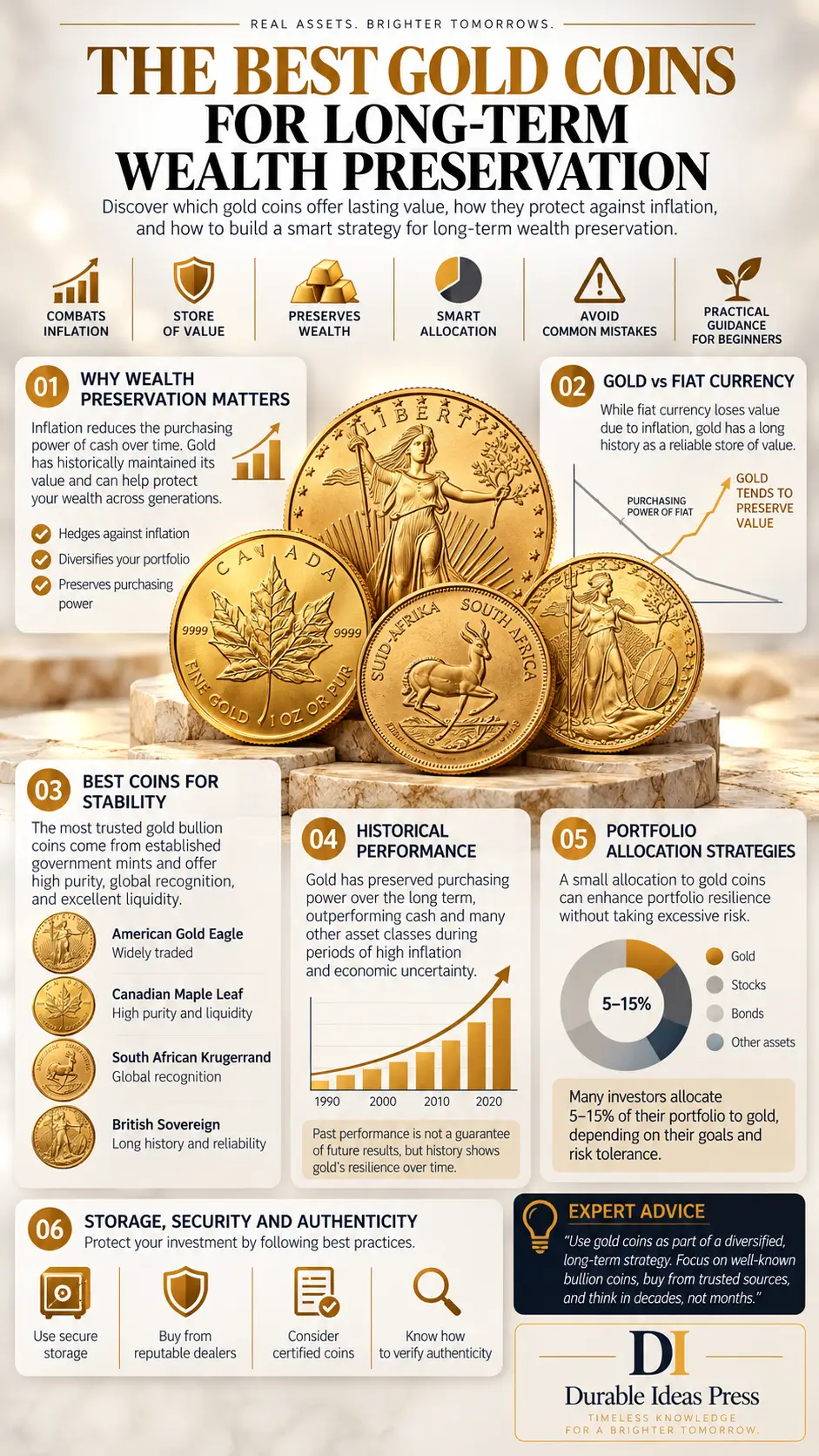
Not every gold coin is equally suited to long-term holding. For wealth preservation purposes, the ideal coin combines maximum liquidity, strong global recognition, low and predictable premiums, and a long track record of acceptance by dealers and institutions worldwide. Here are the strongest options for investors with a multi-decade time horizon.
If your priority is comparing bullion coins more broadly — including purity, premiums, security features, and suitability for different investor profiles — see our guide to the best gold bullion coins.
American Gold Eagle
The American Gold Eagle has been issued by the United States Mint continuously since 1986, making it one of the most established modern bullion coins in existence. It contains 91.67% gold (22-karat), alloyed with silver and copper for durability — a practical consideration for coins intended to be held for decades. It is backed by the US government for weight and gold content, enjoys the deepest liquidity of any gold coin in the North American market, and is recognized by dealers worldwide.
For long-term holders, the Eagle’s durability is a meaningful advantage. A coin that will be handled, stored, and eventually passed to the next generation benefits from the scratch resistance that the 22-karat alloy provides, without any meaningful sacrifice in resale value or pricing transparency.
Canadian Maple Leaf
The Canadian Maple Leaf, issued by the Royal Canadian Mint since 1979, offers 99.99% pure gold — the highest standard purity of any major bullion coin — combined with industry-leading anti-counterfeit technology. Its Bullion DNA system, introduced in 2013, creates a unique digital fingerprint for each coin that can be verified by dealers using a handheld device. For long-term holders concerned about authentication at the point of eventual sale, this feature provides meaningful assurance.
The Maple Leaf’s global recognition is among the strongest of any bullion coin, and its long production history ensures familiarity with dealers across all major markets. It’s an excellent choice for investors who prioritize maximum gold content, modern security features, and broad international resale options.
South African Krugerrand
The Krugerrand, introduced in 1967, is the world’s oldest modern bullion coin and has more decades of trading history than any other coin in this category. Its near-universal recognition — particularly among older dealer networks in Europe, Africa, and North America — reflects nearly sixty years of continuous market presence. Premiums on the Krugerrand are consistently among the lowest of any major bullion coin, and its 22-karat alloy construction provides the same durability advantages as the American Gold Eagle.
For investors with a generational time horizon — those who expect their gold to be held and eventually liquidated by their children or grandchildren — the Krugerrand’s six-decade track record of global acceptance is a significant practical asset. A coin that has been trusted and traded across nearly six decades has a higher probability of remaining liquid and recognized across the decades ahead than a newer entrant to the market.
British Sovereign
The British Sovereign deserves special mention in any long-term wealth preservation context. Originally minted in 1489 and produced continuously in various forms through to the present day, the Sovereign has a track record of global recognition that no modern bullion coin can match. It contains 0.2354 troy ounces of 22-karat gold and has been accepted as a form of payment and a store of value across virtually every country in the world for more than five centuries.
For UK-based investors, Sovereigns carry the same Capital Gains Tax exemption as Britannias. For international investors, the Sovereign’s historical reputation provides a form of recognition that transcends individual country markets — it is understood and accepted in markets where newer coins may be less familiar. This makes it a particularly strong choice for investors who anticipate that their gold may eventually be liquidated in an unfamiliar market or passed across international borders.
Historical Performance
Evaluating gold’s long-term performance requires looking beyond year-to-year returns and considering how it has behaved across complete economic cycles and multi-decade periods.
The Long-Term Purchasing Power Record
The most fundamental measure of gold’s wealth preservation properties is its purchasing power record. As noted above, this record spans centuries and encompasses the rise and fall of entire currency systems. More specifically to modern investors, the gold price in US dollars has risen from $35 per ounce in 1971 (when the US dollar was officially decoupled from gold) to well over $2,000 per ounce in recent years — a nominal increase of more than 5,700%. Over the same period, the US dollar lost more than 85% of its purchasing power. Investors who held gold through this period did not merely preserve their wealth — they significantly increased their real purchasing power.
Performance During Major Crises
Gold’s most valuable characteristic for long-term investors is not its average annual return — it is its behavior during the specific periods when other assets are most vulnerable.
During the 1970s stagflation crisis, when inflation surged and equities stagnated, gold rose from approximately $35 to over $800 per ounce — a return that dwarfed almost every other asset class available to investors at the time.
During the 2008 global financial crisis, equities fell by 40–50% in many major markets. Gold initially dipped briefly but then rose strongly, reaching near-record highs by 2011 as central banks implemented massive stimulus programs whose inflationary implications investors recognized early.
During the COVID-19 pandemic and the inflationary period that followed, gold reached then-record highs above $2,000 per ounce in 2020, then sustained elevated prices through 2021 and 2022 as inflation surged to multi-decade highs. Investors who held gold through this period saw their gold position appreciate while the real value of their cash holdings eroded.
The Periods When Gold Underperforms
Honest evaluation of gold’s long-term record requires acknowledging the periods of underperformance. From 1980 to 2000 — a twenty-year period — gold fell from its all-time high of over $800 per ounce to below $300, representing a significant loss of nominal value. During the same period, equities delivered exceptional returns. This is the clearest historical illustration of gold’s role as a preservation asset rather than a growth asset: it underperformed badly during a period of low inflation, strong economic growth, and rising real interest rates — precisely the conditions that favor financial assets over hard commodities.
This does not diminish gold’s role in a long-term portfolio — it clarifies it. Gold is most valuable as a portfolio component precisely because it does not correlate with the conditions that cause other assets to do well. Holding gold alongside equities and other growth assets reduces the overall volatility of a portfolio and provides protection during the specific crisis periods when growth assets are most likely to fail.
Portfolio Allocation Strategies
Integrating gold into a long-term wealth preservation strategy requires thinking about allocation not as a fixed number but as a function of goals, time horizon, and risk profile.
The Core Allocation Framework
The most commonly cited guideline from portfolio strategists and financial planners is a gold allocation of 5% to 15% of total investment assets. At 5%, gold functions as a modest hedge — providing meaningful protection during crisis periods without significantly dragging returns during extended equity bull markets. At 15%, gold plays a more substantial preservation role, providing stronger insulation against inflationary and monetary crises at the cost of some long-term growth potential.
For investors whose primary goal is wealth preservation rather than growth — particularly those in or approaching retirement, or those managing a family trust or multi-generational fund — allocations toward the higher end of this range, or even beyond it, may be appropriate. The logic is straightforward: as the importance of preserving existing wealth increases relative to growing it, the case for a larger gold allocation strengthens.
Adjusting Allocation Over Time
A simple framework for long-term investors is to increase the gold allocation as the investment time horizon shifts from growth to preservation. An investor in their 30s, with decades of earning ahead, may reasonably hold 5–8% in gold, relying primarily on equities for long-term growth. As that investor moves through their 50s and into retirement, gradually increasing the gold allocation to 12–15% or higher provides progressively stronger insulation against the sequence-of-returns risks and inflationary pressures that matter most when the portfolio is being drawn down rather than built.
Physical Coins vs Paper Gold
For long-term preservation purposes, physical gold coins offer characteristics that paper gold instruments — ETFs, futures, certificates — do not. Physical coins carry no counterparty risk: their value does not depend on any institution remaining solvent, any exchange remaining open, or any financial system continuing to function normally. For investors with a multi-decade time horizon that spans unknown future crises, this counterparty independence is a meaningful structural advantage.
The practical trade-offs — storage costs, insurance, and slightly higher transaction costs — are real but modest relative to the size of most serious preservation portfolios, and they should be weighed against the genuine risk reduction that physical ownership provides.
Dollar-Cost Averaging for Long-Term Accumulation
For investors building a gold position over time rather than making a single large purchase, a consistent, regular buying program — purchasing a fixed value of gold monthly or quarterly regardless of the current price — provides a disciplined framework that removes the pressure of market timing. Over a decade or more, this approach smooths out the average entry price and builds a meaningful position without requiring any view on short-term gold price direction.
Investors making smaller regular purchases may find fractional gold coins particularly useful for implementing this strategy without waiting to fund a full-ounce purchase.
Frequently Asked Questions
What are the best gold coins for long-term wealth preservation?
For most long-term investors, the American Gold Eagle, Canadian Maple Leaf, South African Krugerrand, and British Sovereign represent the strongest options. Each combines deep global liquidity, decades of established market presence, and government backing. The Sovereign’s centuries-long track record makes it particularly notable for investors with a generational time horizon. The Maple Leaf’s 99.99% purity and modern anti-counterfeit technology make it a strong choice for investors who prioritize maximum gold content and authentication assurance.
How much gold should I hold for retirement?
Most financial planning guidance suggests a gold allocation of 5% to 15% of total investment assets for most investors. For retirement-focused investors whose priority is capital preservation over growth, allocations toward the higher end of this range — or beyond — may be appropriate. The key consideration is that gold’s role in a retirement portfolio is primarily defensive: it provides protection against the inflationary and monetary risks that pose the greatest threat to purchasing power over long periods.
Is gold a good investment for the long term?
Gold is not a conventional investment in the growth sense — it does not generate dividends, earnings, or compounding returns. It is, however, an exceptionally well-established store of value over long time horizons, consistently maintaining purchasing power across decades and centuries in a way that paper currencies have not. For long-term investors whose goal is preservation rather than growth, gold’s record is difficult to match.
How do gold coins perform during economic downturns?
Gold’s performance during economic downturns depends on the nature of the crisis. During inflationary crises and monetary instability — when the value of paper currencies is under pressure — gold has historically performed strongly, often dramatically outperforming other asset classes. During deflationary recessions, gold’s performance is more mixed. During severe financial crises involving large-scale monetary expansion (such as the 2008 financial crisis and the COVID-19 pandemic), gold has typically risen strongly as investors recognize the inflationary implications of stimulus measures.
Should I buy gold coins or gold ETFs for long-term preservation?
For a genuine long-term preservation strategy, physical gold coins offer advantages that paper gold instruments do not. The most significant is the absence of counterparty risk: a physical coin’s value depends only on gold itself, not on any fund manager, custodian, exchange, or financial institution. Over a multi-decade time horizon that spans unknown future crises, this structural independence is a meaningful advantage. Gold ETFs remain useful for the portion of gold exposure that benefits from easy liquidity and low transaction costs within a standard brokerage account.
Can I pass gold coins to my heirs?
Yes, gold coins are one of the most practical forms of wealth to transfer across generations. Physical coins can be directly gifted, included in an estate, or held in trust. Their value is universally recognized without requiring a brokerage account, bank relationship, or any financial infrastructure on the part of the recipient. The Krugerrand’s nearly six-decade trading history and the Sovereign’s centuries-long recognition mean these coins will be understood and accepted by dealers and institutions anywhere in the world, regardless of how the financial landscape evolves in the years ahead. Consult a qualified estate planning advisor in your jurisdiction regarding the most tax-efficient structure for your specific situation.
How should I store gold coins held for the long term?
Long-term storage requires a secure, insured solution. Options include a home safe (ideally fireproof, waterproof, and bolted to the building structure), a bank safety deposit box, or professional allocated storage through a specialist vault service. For significant holdings, a combination of storage locations is prudent — concentrating all physical gold in a single location introduces unnecessary risk. Whichever option you choose, ensure the holding is covered by insurance and that trusted family members or advisors know where it is held and how to access it in the event of your incapacity or death.
How do I know if the gold coins I’m buying are genuine?
The most reliable protection is purchasing from accredited bullion dealers, directly from national mint websites, or from other established, verifiable sources. Beyond choosing the right seller, key authenticity checks include verifying the coin’s weight and dimensions against the mint’s published specifications, conducting a magnet test (genuine gold is non-magnetic), performing the ping test (gold produces a distinctive clear ring when tapped), and visually inspecting fine detail under magnification. For higher-value purchases, professional X-ray fluorescence (XRF) testing by a reputable dealer provides definitive verification of metal composition.
For a complete authentication checklist and the warning signs of common scams, see our guide on how to identify fake gold.