
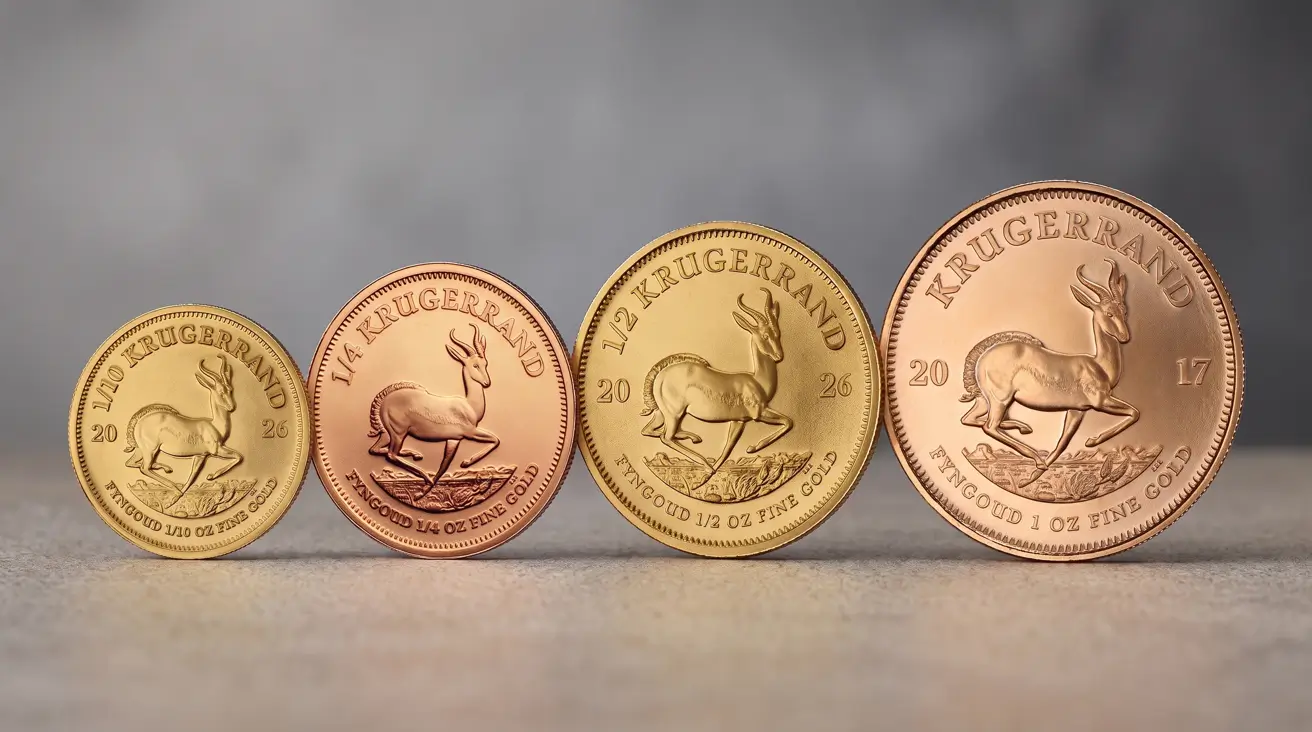
Physical gold ownership has long been associated with large upfront costs — the kind that put it out of reach for investors working with a modest budget. But that picture has changed considerably. Thanks to fractional gold coins, it’s now possible to own genuine, government-minted gold for a few hundred dollars or less, opening the door to an asset class that was once the preserve of wealthier investors.
Fractional gold coins offer the same fundamental benefits as full-ounce bullion — inflation protection, portfolio diversification, and counterparty-free ownership — but in smaller, more accessible sizes. They’re produced by the same national mints that issue full-ounce coins, they’re made of the same high-purity gold, and they’re just as easy to verify and resell.
This guide covers everything a small investor needs to know before purchasing fractional gold coins: what they are, why they make sense for limited budgets, which specific coins represent the best value, and how to understand the premium structure so you’re not paying more than you should. Whether you’re buying your first piece of gold or expanding an existing position in smaller increments, you’ll find the information here to make a confident, well-informed decision.
Prefer to listen?
This article is also available as a podcast episode.
Listen to this episode on Spotify
What Are Fractional Gold Coins?
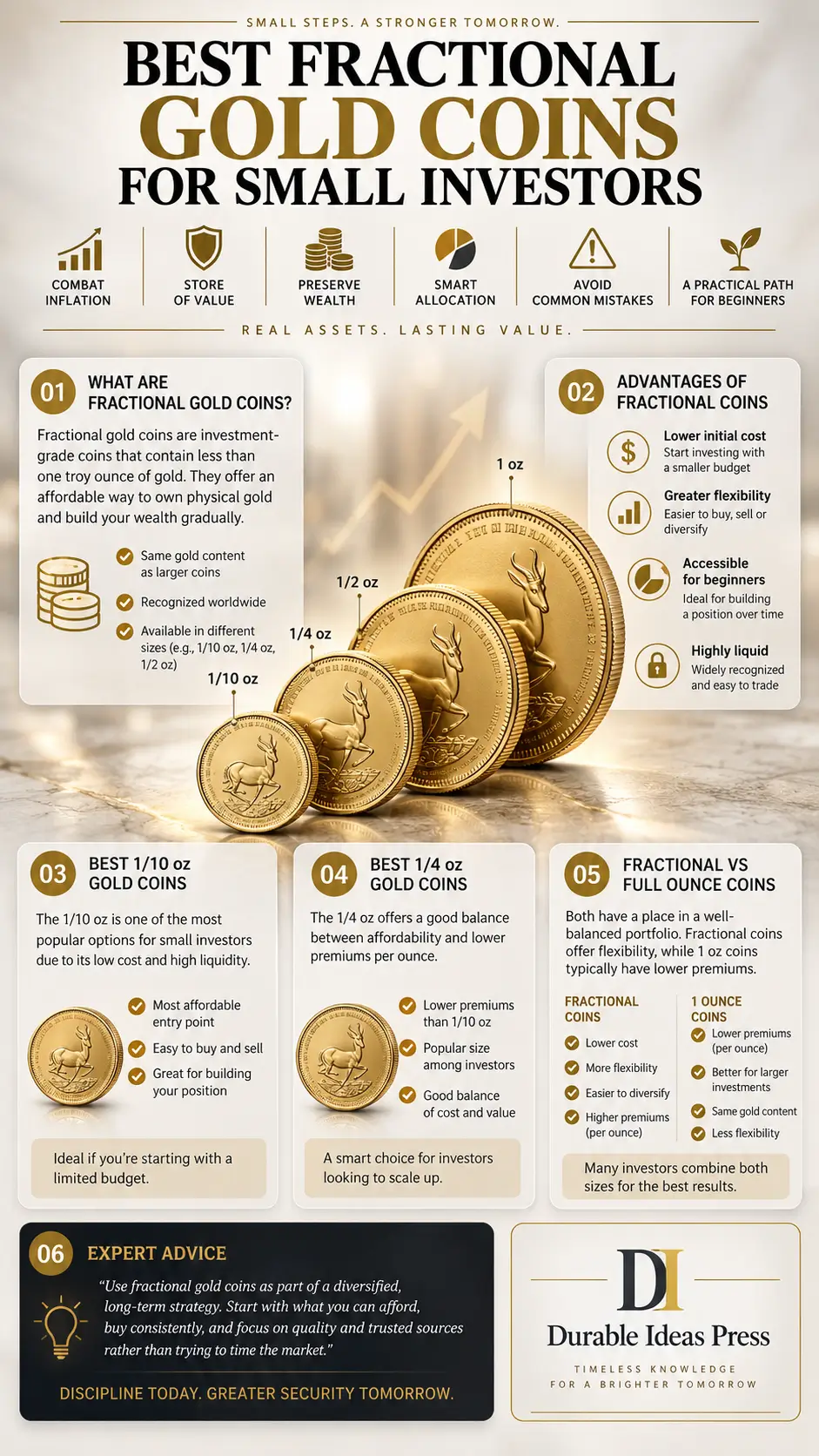
Fractional gold coins are bullion coins produced at weights smaller than the standard one troy ounce. The most commonly available sizes are 1/2 oz, 1/4 oz, and 1/10 oz, though some mints also produce 1/20 oz coins and other non-standard sizes. Each coin contains the stated weight of gold at the same purity as its full-ounce equivalent — for example, a 1/10 oz Canadian Maple Leaf contains exactly 1/10 of a troy ounce of 99.99% pure gold.
These coins are minted by the same official government institutions that produce standard bullion: the United States Mint, the Royal Canadian Mint, the South African Mint, the Royal Mint in the United Kingdom, and others. They carry a legal tender face value in their country of origin, though their actual market value is determined by their gold content and current spot price rather than the printed denomination.
Fractional coins are not to be confused with coin jewelry, novelty gold items, or heavily marketed “collector” coins sold through television shopping channels or aggressive direct-mail campaigns. Those products often carry enormous markups relative to their actual gold content and are very difficult to resell at a fair price. Legitimate fractional bullion coins from established mints are straightforward investment products — their pricing is transparent, their gold content is guaranteed by the issuing government, and they can be bought and sold through any reputable bullion dealer worldwide.
The key appeal is simple: they make gold accessible. A 1/10 oz coin typically costs a few hundred dollars or the equivalent in other currencies, which is within reach of investors who cannot or do not wish to commit the cost of a full-ounce coin in a single purchase.
Whatever size you buy, knowing how to spot fake gold coins becomes especially important when purchasing outside established bullion dealers.
Get our free 2026 Gold Investment Starter Pack here
Advantages of Fractional Coins
Beyond the obvious benefit of a lower entry price, fractional gold coins offer several practical advantages that make them genuinely useful investment tools, not just a budget compromise.
Accessibility and Dollar-Cost Averaging
The most immediate advantage is that fractional coins allow investors to enter the gold market without a large one-time outlay. A full-ounce coin requires a significant upfront commitment; a 1/10 oz coin of the same type costs roughly one-tenth as much. This lower per-purchase cost makes it far easier to invest consistently — buying one or two fractional coins per month, for example, rather than saving for months before making a single larger purchase. This approach, known as dollar-cost averaging, smooths out the average entry price over time and removes the pressure of trying to time the market.
Flexibility and Partial Liquidation
A full-ounce gold coin is an indivisible unit. If you need to liquidate part of your gold position — whether for an emergency or a planned expense — you must sell the entire coin. Fractional coins solve this problem by allowing you to sell only as much gold as you need. An investor who holds ten 1/10 oz coins can sell one or two while keeping the rest, maintaining their overall gold position while accessing some liquidity. This flexibility is one of the most practical, underappreciated benefits of holding gold in smaller denominations.
Gifting and Estate Planning
Fractional gold coins are widely used as gifts and for estate planning purposes. Their manageable size and value make them practical to give as meaningful gifts for significant life events, and they’re easy to divide among multiple beneficiaries as part of an estate. A collection of fractional coins is far easier to distribute equitably than a single full-ounce coin or a large bar.
For a broader strategy focused on inheritance and multi-decade ownership, see our guide to preserving wealth with gold.
Same Quality, Different Size
It’s worth emphasizing that fractional coins are not a lower tier of product. They’re produced by the same mints, using the same gold, with the same anti-counterfeit features and government guarantees as full-ounce coins. The only meaningful difference — beyond size and price — is that fractional coins carry a somewhat higher premium as a percentage of gold content, which is explained in detail in the premiums section below.
If this will be your first physical gold purchase, our guide to gold coin investing for beginners covers the full buying process, including dealers, storage, authenticity, and common mistakes.
Best 1/10 oz Gold Coins
The 1/10 oz size is the most popular entry point for small investors and is widely available from multiple mints. Here are the best options in this size.
American Gold Eagle (1/10 oz)
The 1/10 oz American Gold Eagle is one of the most recognized and liquid fractional gold coins in the world. Issued by the United States Mint, it contains 1/10 troy ounce of gold at 91.67% purity (22-karat), alloyed with silver and copper for durability. It carries a $5 face value and is backed by the US government for weight and purity. Its universal recognition makes it easy to buy and sell through dealers worldwide, and premiums are competitive for this size. It’s an excellent first fractional coin for most investors.
Canadian Maple Leaf (1/10 oz)
The 1/10 oz Canadian Maple Leaf contains 99.99% pure gold — the highest standard purity of any major bullion coin — and includes the Royal Canadian Mint’s Bullion DNA anti-counterfeit technology, making it one of the most secure fractional coins available. Its high purity makes pricing and comparison simple and transparent. Premiums are competitive, global recognition is strong, and it’s a top choice for investors who prioritize maximum gold content and security features in a small coin.
South African Krugerrand (1/10 oz)
The Krugerrand is the world’s original modern bullion coin, first introduced in 1967, and its fractional sizes inherit the same near-universal dealer recognition of the full-ounce version. The 1/10 oz Krugerrand contains 91.67% gold (22-karat) and consistently carries some of the most competitive premiums of any fractional coin, making it a strong choice for investors focused on value per gram of gold. Its long history and global familiarity make it one of the easiest fractional coins to resell anywhere in the world.
British Britannia (1/10 oz)
The 1/10 oz Britannia, issued by the Royal Mint, contains 99.99% fine gold and features advanced anti-counterfeit technology including surface animation and tincture line engraving. For investors based in the United Kingdom, it carries the additional benefit of being exempt from Capital Gains Tax as legal tender, making it particularly tax-efficient for UK residents. Its recognition outside the UK has grown steadily in recent years, though the Eagle and Krugerrand remain more universally liquid in many markets.
Best 1/4 oz Gold Coins
The 1/4 oz size offers a middle ground between the accessibility of 1/10 oz coins and the lower per-gram premium of larger sizes. These are the strongest options.
American Gold Eagle (1/4 oz)
The 1/4 oz Gold Eagle carries a $10 face value and offers a somewhat lower premium percentage than its 1/10 oz counterpart, while still being accessible at a price well below a full-ounce coin. It shares all the characteristics of the full-ounce Eagle — government backing, 22-karat gold, and deep global liquidity — making it a natural stepping stone for investors who have started with 1/10 oz coins and want to build their position more efficiently.
Canadian Maple Leaf (1/4 oz)
The 1/4 oz Maple Leaf maintains the 99.99% purity and Bullion DNA security features of its larger sibling, with a premium that is proportionally lower than the 1/10 oz version. For investors who have a slightly larger per-purchase budget and want to minimize the premium paid per gram of gold, the 1/4 oz Maple Leaf is one of the most efficient fractional coins available. It’s an excellent choice for investors building a consistent monthly or quarterly gold position.
Austrian Philharmonic (1/4 oz)
The 1/4 oz Austrian Philharmonic, produced by the Austrian Mint, is a 99.99% pure gold coin that is among the most popular bullion coins in Europe and has strong global recognition. Its elegant design — featuring musical instruments from the Vienna Philharmonic Orchestra — is widely regarded as one of the most attractive in the bullion world. Premiums are competitive, and it’s particularly easy to buy and sell throughout continental Europe and internationally. For investors outside North America looking for a high-quality fractional coin with strong regional market presence, the Philharmonic is an excellent alternative to the Eagle or Maple Leaf.
Fractional vs Full Ounce Coins
Understanding the trade-offs between fractional and full-ounce coins helps investors allocate their gold purchases more strategically rather than treating the two formats as simple substitutes.
The Case for Full Ounce
Full-ounce coins carry lower premiums as a percentage of gold content than fractional coins. This means that for every dollar spent, a greater proportion goes toward actual gold ownership rather than minting and distribution costs. For investors with the budget to buy full-ounce coins comfortably, this efficiency is a real advantage over time, particularly for large or long-term positions. Full-ounce coins are also the most universally liquid format — the deepest pool of buyers exists for standard one-ounce bullion, which can make resale marginally smoother in some markets.
If your budget allows you to consider full-ounce options, our comparison of the best gold bullion coins examines the leading coins by purity, premiums, liquidity, and security.
The Case for Fractional
The advantages of fractional coins are primarily practical rather than economic. They require less capital per purchase, enabling consistent investing through dollar-cost averaging. They allow partial liquidation without selling an entire position. They’re more practical for gifting. And they provide flexibility that a collection of full-ounce coins simply cannot match.
The premium cost of fractional coins is real, but it should be weighed against these practical benefits. For an investor who would otherwise have to wait six months before accumulating enough funds to buy a single full-ounce coin, buying fractional coins monthly means six months of gold ownership, six months of inflation protection, and six data points of market experience rather than one.
A Practical Hybrid Approach
Many experienced investors use both. A common strategy is to purchase fractional coins for regular monthly contributions — taking advantage of their accessibility and dollar-cost averaging benefits — while making occasional full-ounce purchases when budget allows, keeping the overall premium cost of the portfolio moderate. This approach combines the efficiency of full-ounce coins with the flexibility and accessibility of fractional sizes.
Premiums Explained
Understanding how premiums work is essential for any fractional gold coin investor, since the premium is what separates a well-priced purchase from an overpriced one.
What Is a Premium?
A premium is the amount you pay above the gold spot price — the current market price of one troy ounce of gold. It covers the costs of minting (the physical production of the coin), distribution (getting it from the mint to the dealer), and the dealer’s margin. For example, if the gold spot price is $2,400 per troy ounce and a 1 oz coin sells for $2,520, the premium is $120, or 5%.
Why Fractional Coins Have Higher Premiums
The minting cost of a 1/10 oz coin is not one-tenth the minting cost of a 1 oz coin — the mechanical process, quality control, packaging, and handling costs are similar regardless of size. These fixed costs, spread over less gold, result in a higher premium per ounce of gold content. As a general guide, expect:
- 1 oz coins: 3–8% premium above spot
- 1/4 oz coins: 7–14% premium above spot
- 1/10 oz coins: 10–20% premium above spot
These ranges vary by coin type, mint, and current market demand. Buying from a high-volume, competitive dealer tends to yield premiums toward the lower end of these ranges; purchasing through a retail outlet or less competitive source will typically mean higher premiums.
How to Compare Premiums
Always calculate the premium as a percentage of the spot price before buying, not just as a nominal dollar amount. A $30 premium on a 1/10 oz coin when spot is $240 per 1/10 oz is a 12.5% premium — meaningful but within the normal range. The same $30 premium on a 1/4 oz coin when spot is $600 per 1/4 oz is only a 5% premium — very competitive.
Comparing premiums across at least two or three reputable dealers before purchasing is always worth the effort. For a $300–$400 purchase, even a 3–4% difference in premium represents $10–$15 of real money, and the habit of comparison shopping compounds meaningfully over time for investors who buy regularly.
When Premiums Rise
During periods of high market demand — typically when financial stress or inflation fears are prominent — premiums on fractional coins can spike well above their normal ranges. Investors who buy during these peak periods pay more per gram of gold. This is another argument for building a fractional gold position steadily over time rather than making large reactive purchases during periods of elevated market concern.
If inflation protection is one of your main reasons for owning gold, see our guide on how to protect wealth from inflation without turning gold into a reactive bet.
Frequently Asked Questions
What are the best fractional gold coins for beginners?
For most beginners, the 1/10 oz American Gold Eagle or Canadian Maple Leaf are the strongest starting points. Both are issued by major government mints, are universally recognized by dealers worldwide, and offer straightforward, transparent pricing. The Eagle is particularly well-suited to investors in the Americas; the Maple Leaf is an excellent global choice thanks to its 99.99% purity and advanced anti-counterfeit features.
Are fractional gold coins a good investment?
Yes, for investors who cannot or prefer not to commit the full cost of a one-ounce coin per purchase. Fractional coins offer genuine gold ownership with all the associated benefits — inflation protection, portfolio diversification, and counterparty-free value — at a lower entry price. The main cost is a higher premium percentage compared to full-ounce coins, which is the price of accessibility and flexibility.
What is the cheapest fractional gold coin to buy?
The South African Krugerrand in 1/10 oz typically carries some of the lowest premiums among major fractional bullion coins, making it one of the most cost-efficient options per gram of gold. Premiums vary by market and timing, so it’s worth comparing current dealer prices across a few options before purchasing.
How much does a 1/10 oz gold coin cost?
The cost of a 1/10 oz gold coin equals the current spot price of 1/10 of a troy ounce of gold, plus the dealer’s premium. At a gold spot price of $2,400 per troy ounce, the gold content alone is worth $240. With a typical premium of 10–15%, a 1/10 oz coin would cost approximately $264–$276 from a competitive dealer. Prices fluctuate with the gold spot price.
Is it better to buy one full-ounce coin or multiple fractional coins?
This depends on your goals and budget. If your priority is minimizing the premium paid per gram of gold, a full-ounce coin is more cost-efficient. If your priority is accessibility, the ability to dollar-cost average with regular smaller purchases, or the flexibility to partially liquidate your position without selling an entire coin, fractional coins offer meaningful advantages that can outweigh the higher premium cost.
Can I sell fractional gold coins easily?
Yes, fractional coins from major mints — American Gold Eagle, Canadian Maple Leaf, South African Krugerrand, British Britannia, and Austrian Philharmonic — are accepted by reputable bullion dealers worldwide. The resale process is straightforward: most dealers will quote a buy price (spot price minus a small spread) on sight for any of these coins. Obscure or regional fractional coins may be harder to sell at a fair price, which is one reason it’s advisable to stick to the most widely recognized options.
What size fractional gold coin should I start with?
For most first-time buyers, the 1/10 oz size is the most accessible and practical starting point. It represents a meaningful but not excessive initial commitment, allows you to start building a gold position immediately rather than saving for a larger purchase, and gives you direct experience with the buying and ownership process. As your budget and confidence grow, you can move toward 1/4 oz or full-ounce purchases for greater capital efficiency.
Are fractional gold coins real gold?
Yes. Fractional bullion coins from established government mints contain exactly the stated weight of gold at the specified purity, guaranteed by the issuing authority. A 1/10 oz Canadian Maple Leaf contains 1/10 of a troy ounce of 99.99% pure gold — there is no difference in quality between a fractional coin and a full-ounce coin from the same mint. The only differences are size, weight, and the premium structure.