
Buying gold should be one of the most straightforward financial decisions you can make. The asset is thousands of years old, the market is global, and the value is simple to track. Yet the gold coin market attracts a persistent and growing number of fraudsters, from crude counterfeiters producing obvious fakes to sophisticated operators running schemes that deceive even experienced collectors. For every legitimate dealer offering transparent pricing and genuine bullion, there are others — some brazen, some subtle — looking to exploit investors who don’t know what to look for.
The good news is that protecting yourself requires neither advanced chemistry nor specialist equipment. Most gold coin fraud can be detected or avoided entirely with a combination of basic knowledge, sensible purchasing habits, and awareness of a handful of well-documented red flags. The investors who get defrauded are rarely naive — they simply weren’t aware of the specific patterns that distinguish a legitimate transaction from a scam.
This guide covers the full picture: why fraud in the gold coin market is increasing, what the most common fakes look like, how to test a coin’s authenticity using straightforward methods, where to buy safely, and which warning signs should prompt you to walk away from a deal. By the end, you’ll have the knowledge to buy gold coins with genuine confidence.
Prefer to listen?
This article is also available as a podcast episode.
Listen to this episode on Spotify
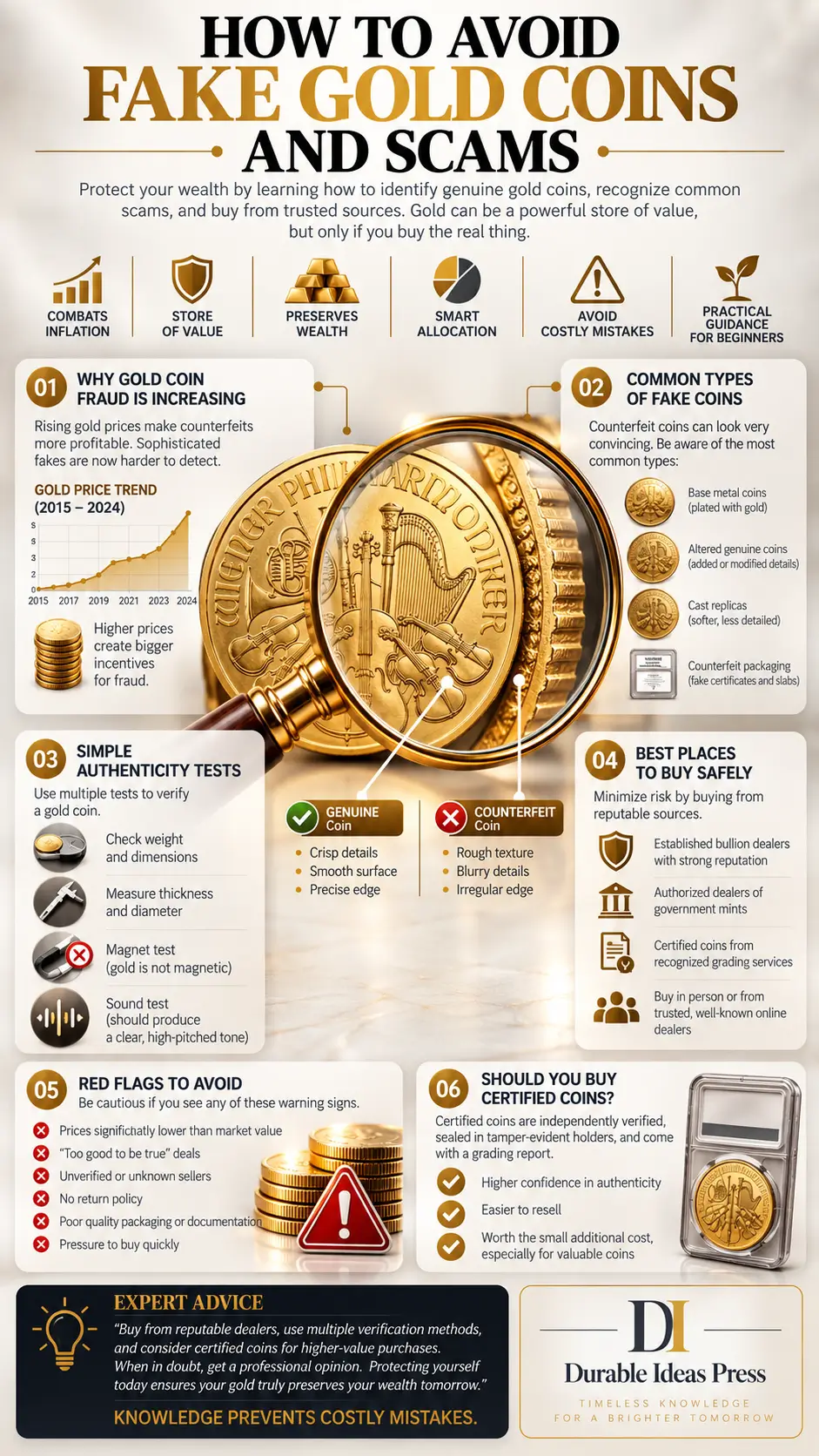
Why Gold Coin Fraud Is Increasing
Understanding why gold coin fraud has grown helps explain why the precautions in this guide matter more today than they did a decade ago.
Rising Gold Prices Create Larger Incentives
The most fundamental driver of increased gold coin fraud is the sustained rise in gold prices over the past two decades. When an ounce of gold was worth a few hundred dollars, the effort and risk involved in counterfeiting gold coins produced limited returns for criminals. With gold trading at or near record highs — above $2,000 per ounce for extended periods in recent years — the financial incentive to produce convincing counterfeits has grown dramatically. Higher prices mean higher potential profits per fake coin, which attracts more sophisticated and better-resourced fraudsters to the market.
Online Marketplaces Expand the Opportunity
The growth of online selling platforms — auction sites, social media marketplaces, classified ad platforms, and peer-to-peer trading apps — has created vast new channels for gold coin fraud. These platforms offer anonymity, global reach, and minimal accountability. A fraudster in one country can sell fake coins to buyers anywhere in the world, often operating under multiple accounts and abandoning each one after complaints accumulate. The physical distance between buyer and seller means the coin can’t be inspected before payment, and dispute resolution on many platforms is slow and uncertain.
Improved Counterfeiting Technology
The equipment available to counterfeiters has improved significantly. Tungsten — a metal with a density very close to gold’s — is widely available and can be used to produce gold-plated coins that pass basic weight tests. Precision milling equipment makes it possible to replicate surface detail with increasing accuracy. Some modern counterfeits are sophisticated enough that casual visual inspection won’t reveal them as fakes. This technological escalation means that methods that once provided reasonable assurance of authenticity — simply looking at a coin, feeling its weight — are no longer sufficient on their own.
Inexperienced Buyers Entering the Market
Periods of economic uncertainty and rising inflation consistently draw new investors into the gold market, many of whom have limited experience with physical gold. Fraudsters actively target this demographic, knowing that inexperienced buyers are less likely to know what questions to ask, less familiar with what legitimate coins look, feel, and sound like, and more susceptible to urgency tactics and misleading claims about coin rarity or value.
Get our free 2026 Gold Investment Starter Pack here
Common Types of Fake Coins
Not all fake gold coins are created equal. Understanding the different categories of counterfeits helps you know what you’re protecting against.
Gold-Plated Base Metal Coins
The simplest and most common fake is a coin made from a base metal — typically brass, copper, or zinc alloy — that has been plated with a thin layer of gold. These fakes are relatively easy to produce and can look convincing at a glance, particularly if the plating is applied over a well-made die. However, they fail basic density tests because base metals are significantly less dense than gold, and the plating typically wears away at the edges with handling, revealing the base metal beneath. These fakes are most commonly encountered in informal settings — flea markets, online classifieds, and social media sales — rather than through established dealers.
Tungsten-Core Fakes
A more sophisticated and dangerous category is the tungsten-core fake. Tungsten has a density of approximately 19.3 g/cm³, extremely close to gold’s 19.3 g/cm³, which means a coin with a tungsten core and a gold cladding layer will pass basic weight tests that catch base-metal fakes. These counterfeits require more advanced production capability and are accordingly more expensive to produce, which means they tend to be targeted at higher-value coins. They cannot be reliably identified by weight or casual visual inspection — detecting them typically requires ultrasonic testing, X-ray fluorescence (XRF) analysis, or a precise specific gravity test.
Altered Dates and Mint Marks
Some “fakes” are actually genuine gold coins that have been altered to increase their apparent numismatic value. A common date with low collector value might have its date altered to match a rare, high-value date of the same coin series, transforming a coin worth close to its melt value into one that appears to be worth many times more. These alterations require careful examination of the date and mint mark under magnification, comparison with reference images, and ideally professional grading to verify.
Counterfeit Certified Coins
A particularly sophisticated scam involves fake grading service holders — the tamper-evident plastic capsules used by professional grading services like PCGS and NGC to encapsulate and authenticate coins. Some counterfeiters produce fake holders containing either a fake coin or a genuine coin that doesn’t match the described grade on the label. These can be verified by cross-referencing the certification number printed on the holder with the grading service’s online database, which should return an exact match including the specific coin’s description, grade, and images.
Overpriced Legitimate Coins
Not all gold coin fraud involves physically fake coins. A common and legal-gray-area scam involves selling genuine gold coins at prices dramatically above their fair market value, often by misrepresenting their rarity, historical significance, or investment potential. This is particularly common with commemorative coins, “limited edition” products, and older coins marketed through high-pressure sales channels. The coin is real gold, but the buyer pays two, three, or more times what it’s actually worth, making any future resale at a loss almost inevitable.
Simple Authenticity Tests
Several practical tests can be performed without specialist equipment and provide meaningful assurance of a coin’s authenticity.
The Magnet Test
Gold is not magnetic. If a coin is strongly attracted to a powerful magnet, it contains ferrous metal and is definitely not genuine gold. This test is quick and costs nothing — a strong neodymium magnet is all that’s needed. However, it’s important to understand the limitation: the magnet test only catches fakes made from magnetic metals. Brass, copper, tungsten, and other common counterfeit materials are also non-magnetic, so passing the magnet test does not confirm authenticity — it only rules out one category of fake.
Weight and Dimensions
Every bullion coin has precisely specified weight and dimensions, published by the issuing mint and readily available online. A 1 oz American Gold Eagle, for example, weighs exactly 33.931 grams and measures 32.7 mm in diameter and 2.87 mm in thickness. A precise digital scale (accurate to 0.01 grams) and a digital caliper allow you to verify these specifications quickly. A coin that fails on either measurement is almost certainly not genuine. This test is particularly effective at catching base-metal fakes, which typically have noticeably different weights.
The Ping Test
Gold produces a distinctive, clear, high-pitched ringing tone when struck lightly — a sound often described as a “ping” or bell tone that sustains for a moment. Base metals produce a shorter, duller sound. This test can be performed by balancing the coin on a fingertip and tapping the edge gently with another coin or a small object, listening to the resulting sound. Free smartphone apps are also available that analyze the sound produced by a tapped coin and compare it against a database of known genuine coins. This test is most reliable for full-ounce coins; results for smaller fractional coins are less distinct.
If you’re considering smaller denominations, our guide to fractional gold coins compares the leading 1/10 oz and 1/4 oz options and their trade-offs.
Visual Inspection Under Magnification
A jeweler’s loupe (10x magnification is standard) allows you to examine surface detail, edge lettering, and any reeding (the ridged pattern around the edge of many coins). Genuine coins from major mints have sharply defined details with clean, precise lines. Counterfeits often show slightly blurry or doubled detail, uneven reeding, or subtle differences in the proportions of design elements. Comparing the coin under magnification to high-resolution reference images from the issuing mint is a reliable way to identify discrepancies.
Specific Gravity Test
Gold has a specific gravity of 19.32, meaning it is 19.32 times denser than an equal volume of water. The specific gravity of a coin can be calculated by weighing it in air, then weighing it while submerged in water, and applying a simple formula. This test requires a digital scale and a container of water, and it’s highly reliable at identifying non-gold metals — including tungsten, whose density is similar but not identical to gold’s. A coin with a specific gravity significantly different from 19.32 is not pure gold.
Professional XRF Testing
X-ray fluorescence (XRF) testing is the most reliable non-destructive method for determining the metal composition of a coin. XRF devices fire X-rays at the coin’s surface and analyze the energy spectrum of the reflected radiation to identify the metals present and in what proportions. This test can identify gold plating over a different core metal, detect tungsten-core constructions, and verify purity claims. Many reputable bullion dealers and pawn shops have XRF devices on-site and will use them to verify coins they’re buying or can test coins for a modest fee.
Best Places to Buy Safely
The single most effective protection against gold coin fraud is simply buying from the right sources. Most of the tests described above become largely unnecessary when you purchase from a reputable, established dealer.
Accredited Bullion Dealers
The most reliable purchasing channel for most investors is an accredited bullion dealer — a business that is a member of recognized industry associations and has an established track record. In the United States, look for members of the Industry Council for Tangible Assets (ICTA) or the Professional Numismatists Guild (PNG). In the United Kingdom, the British Numismatic Trade Association (BNTA) and London Bullion Market Association (LBMA) accreditation are reliable indicators. These memberships require adherence to codes of conduct and provide a layer of accountability that informal sellers lack.
If you’re making your first purchase, our guide to gold coin investing for beginners covers the complete process from choosing a coin and dealer to budgeting, storage, and resale.
Directly from Government Mints
Several national mints sell directly to the public through their own online stores, including the United States Mint, the Royal Canadian Mint, and the Royal Mint in the United Kingdom. Purchasing directly from the issuing mint is the highest possible assurance of authenticity — you’re buying straight from the source. Premiums from mint stores are sometimes slightly higher than competitive dealer pricing, but the absolute elimination of authenticity risk can make this worthwhile, particularly for first-time buyers.
Established Online Dealers with Verified Track Records
Major online bullion dealers — such as APMEX, JM Bullion, and BullionVault, among others — have been operating for many years, process large transaction volumes, and have strong reputations to protect. They source directly from mints and authorized distributors, and they guarantee authenticity. Look for dealers that publish their buyback prices transparently, have verified customer reviews across multiple independent platforms, and offer clear return policies.
Authorized Secondary Market Dealers
The secondary market — where previously owned coins are bought and sold — is legitimate and can offer competitive prices. Established coin dealers who handle secondary market coins typically authenticate purchases before reselling them, and many use XRF testing or other verification methods as standard practice. The key is to ensure you’re dealing with an established business rather than a private individual, whose authenticity guarantees are much weaker.
Once you’ve chosen a trustworthy source, our comparison of the best gold bullion coins can help you decide which widely recognized coin fits your priorities.
Red Flags to Avoid
Knowing which warning signs indicate a potentially fraudulent situation is as important as knowing where to buy safely.
Prices Below Spot Value
Genuine gold cannot legitimately be sold at or below the spot price by a profit-seeking seller. If someone is offering gold coins at prices that seem too low — significantly below the prevailing market price — the most probable explanation is that the coins are not genuine. This applies regardless of the story offered: “estate sale liquidation,” “urgent sale,” “private collection” — the economics of selling real gold below market value simply don’t add up. Prices well below spot are the single clearest red flag in gold coin fraud.
High-Pressure Urgency Tactics
Legitimate dealers never pressure buyers into immediate decisions. If a seller is telling you the price is only available “today,” that the coins are about to be “claimed by another buyer,” or that you need to commit now before the opportunity disappears, treat this as a serious warning sign. Urgency tactics are a classic manipulation technique used across many categories of fraud, and they’re particularly common in numismatic scams where inflated valuations are used to create a false sense of opportunity.
Unsolicited Contact
Unsolicited approaches — phone calls, emails, social media messages, or online advertisements that come to you rather than the other way around — offering gold coin investment opportunities warrant immediate skepticism. Legitimate bullion dealers rely on their reputation and competitive pricing to attract customers; they don’t need to cold-call or cold-email investors.
Unverifiable or Vague Claims About Rarity
Sellers who make dramatic claims about a coin’s rarity, historical significance, or investment potential — but cannot support those claims with independently verifiable documentation — are exhibiting a common pattern of numismatic fraud. Genuine rare coins have documented provenance, professional grading from recognized services, and verifiable auction records. Vague claims like “very rare” or “only a few known to exist” without supporting evidence are meaningless.
Private Sellers on Unregulated Platforms
Buying gold coins from unknown private sellers on social media, peer-to-peer trading apps, or classified advertisement platforms carries significantly higher risk than buying from an established dealer. There’s no accountability, no authentication guarantee, and limited recourse if the coin turns out to be fake. If you do consider buying from a private seller, insist on in-person inspection, have the coin tested before completing the transaction, and use an escrow or platform payment method that offers buyer protection.
Should You Buy Certified Coins?
Certified coins — those that have been professionally graded and encapsulated by a recognized grading service — offer a meaningful layer of authentication that can simplify the buying process and provide additional confidence, particularly for investors who are less experienced with physical gold.
What Certification Provides
The two most widely recognized grading services in the world are the Professional Coin Grading Service (PCGS) and the Numismatic Guaranty Company (NGC). When these services certify a coin, they authenticate it as genuine, assess its condition on a standardized scale, and seal it in a tamper-evident plastic holder with a unique certification number. This certification number can be verified against the grading service’s online database, which returns detailed information about the specific coin — including its assigned grade and, for many coins, images.
For investors buying bullion coins primarily for their gold content, certification adds an authentication assurance that reduces the need to perform independent testing. For investors in historical or numismatic coins, certification is essentially indispensable — without it, the risk of overpaying for misrepresented grades or altered coins is substantial.
The Limitations
Certified coins do carry higher prices than uncertified equivalents, partly because grading services charge fees that are reflected in the resale price, and partly because certified coins command a premium in the secondary market for the assurance they provide. For standard bullion coins purchased from accredited dealers, this premium may not be necessary — the authentication risk is already low, and the certification cost represents an additional expense with limited incremental benefit.
The fake holder scam mentioned earlier is also worth keeping in mind: always verify a certification number directly on the grading service’s official website rather than relying on the holder alone.
When Certification Is Most Valuable
Certification provides the greatest value in three specific situations: when buying historical or numismatic coins where condition significantly affects value; when buying from secondary market sources rather than accredited primary dealers; and when buying higher-value coins where the cost of the grading service premium is small relative to the total transaction value and the peace of mind is worth the additional cost.
If you’re unsure why certification matters much more for collectible coins, our guide to bullion vs numismatic coins explains the fundamental difference between the two markets.
Frequently Asked Questions
How can I tell if a gold coin is real?
The most reliable combination of home tests is weight and dimension verification (using a precise scale and digital caliper, compared against the mint’s published specifications), the magnet test (genuine gold is not magnetic), the ping test (gold produces a clear, sustained ringing tone when tapped), and visual inspection under magnification (checking that design details match high-resolution reference images from the issuing mint). For higher-value coins, professional XRF testing by a reputable dealer provides definitive verification.
What are the most common gold coin scams?
The most common scams include: selling gold-plated base metal coins as genuine gold; selling tungsten-core coins that pass basic weight tests; overpricing common coins by misrepresenting their rarity or investment potential; selling uncertified coins at inflated numismatic premiums based on false rarity claims; and listing fake coins through online marketplaces with no accountability or buyer protection.
Is it safe to buy gold coins online?
Yes, when buying from established, accredited bullion dealers with verifiable track records. Major online dealers source directly from mints, guarantee authenticity, and have reputations built over many years of operation. What is not safe is buying from unknown private sellers on social media, peer-to-peer platforms, or classified ad sites, where there is no accountability and the risk of receiving a counterfeit is significantly higher.
What does a fake gold coin look like?
Many well-made fakes are visually indistinguishable from genuine coins to the naked eye — this is precisely what makes them dangerous. However, common visual tells in lower-quality fakes include slightly blurry or imprecise surface detail, uneven or irregular edge reeding, color that is subtly off (too yellow, too orange, or slightly inconsistent), and edges that show base metal where the gold plating has worn. Comparison under 10x magnification with high-resolution reference images from the issuing mint reveals discrepancies that aren’t visible to the naked eye.
What is the safest way to buy gold coins?
The safest approach is to purchase from an accredited bullion dealer or directly from a national mint’s official website. Both channels provide strong authenticity guarantees, transparent pricing, and recourse if something goes wrong. Paying a slight premium for this assurance is almost always worthwhile, particularly for investors who are newer to the market and less equipped to independently verify a coin’s authenticity.
Should I buy certified gold coins?
Certified coins from recognized grading services like PCGS or NGC provide a useful layer of authentication assurance, and they’re particularly valuable when buying historical or numismatic coins, buying from secondary market sources, or purchasing higher-value individual coins. For standard bullion coins from accredited dealers, certification is helpful but not strictly necessary — the authentication risk is already low through reputable dealers.
How do I verify a certified coin is genuine?
Go directly to the official website of the grading service shown on the holder (PCGS.com or NGCcoin.com) and enter the certification number printed on the label. The database will return the specific coin’s details, grade, and images. If the number returns no result, returns information that doesn’t match the coin in hand, or the holder shows any signs of tampering, treat the coin as suspect and do not complete the purchase.
What should I do if I think I’ve been sold a fake gold coin?
First, have the coin professionally tested by an independent party — an established bullion dealer with XRF equipment is the most accessible option. If the coin is confirmed to be fake, report the fraud to local law enforcement and, if the purchase was made online, to the platform where the transaction occurred. If you paid by credit card, contact your card issuer to initiate a chargeback. Preserve all records of the transaction — receipts, communications, seller information — as evidence. If the seller is a business, report them to the relevant consumer protection authority in your jurisdiction.