

Inflation is one of the most persistent threats to personal wealth. It doesn’t announce itself loudly — it works quietly in the background, gradually reducing the purchasing power of every unit of currency you hold. A savings account that felt secure a decade ago may today buy significantly less than it did when you opened it, even if the balance has grown slightly in nominal terms. This is the insidious nature of inflation: it doesn’t take money from you directly, it simply makes the money you have worth less.
Gold has served as a response to this problem for thousands of years. Across different civilizations, currencies, and economic systems, it has consistently maintained purchasing power over the long run in a way that paper money has not. Today, that same property makes it one of the most widely recommended tools for protecting wealth during inflationary periods.
This article explains exactly how inflation damages savings, why gold holds its value when currency doesn’t, and how to use gold practically — through coins, bars, or financial instruments — to protect your wealth. Whether you’re building a long-term position or responding to a specific period of rising prices, you’ll find a clear, evidence-based framework for making gold work in your portfolio.
Prefer to listen?
This article is also available as a podcast episode.
Listen to this episode on Spotify
Why Inflation Destroys Savings
To understand why gold is such a useful inflation hedge, it helps to first understand precisely what inflation does and how its effects compound over time.
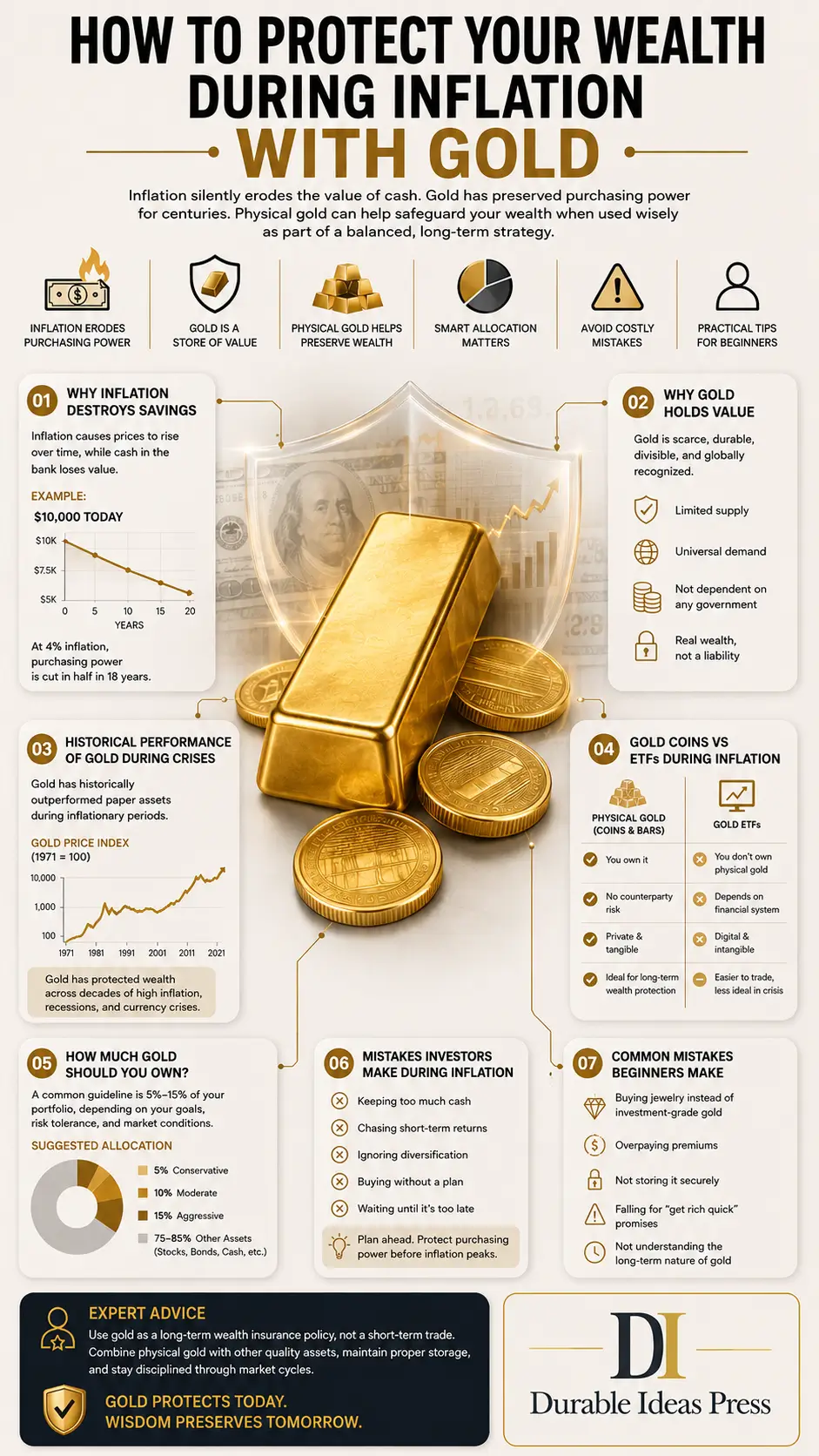
At its simplest, inflation is the rise in the general level of prices across an economy. When inflation runs at 5% per year, something that costs $100 today will cost $105 next year, $110.25 the year after, and so on. Over a decade of consistent 5% inflation, that same item would cost more than $162. If your savings haven’t grown at least as fast, your real purchasing power — what your money can actually buy — has declined substantially.
The most common place people store savings is in bank deposit accounts, which offer modest interest rates set by the banking institution. The critical issue is that these rates are frequently lower than the rate of inflation, meaning that even as the nominal value of your deposit grows, its real value shrinks. This is called a negative real interest rate, and it has been a persistent feature of many economies, particularly following the large-scale monetary policy interventions of recent decades.
Beyond deposit accounts, inflation also erodes the real value of bonds and fixed-income instruments. A bond that pays a fixed 3% annual interest becomes a poor investment when inflation is running at 6% — its real return is negative. Equities offer more protection in theory, since companies can raise prices to keep up with inflation, but in practice equity markets often react poorly to the rising interest rates that typically accompany inflationary periods, creating significant short-term volatility.
Cash is the most directly affected of all. Holding substantial cash savings during a period of high inflation is essentially a losing strategy — every month that money sits idle, it is worth slightly less in real terms. The challenge, then, is to find an asset whose value keeps pace with or exceeds inflation. This is where gold has historically stepped in.
Get our free 2026 Gold Investment Starter Pack here
Why Gold Holds Value
Gold’s ability to hold value during inflationary periods isn’t accidental — it stems from a set of characteristics that are fundamentally different from those of paper currency and most financial assets.
Scarcity
Gold cannot be printed, digitally created, or manufactured at will. The global supply of gold grows by roughly 1–2% per year, determined by the pace of mining. This is in stark contrast to fiat currencies, which can be created in any quantity by central banks, often in response to economic crises or policy decisions. When more currency enters circulation without a corresponding increase in goods and services, each unit of currency buys less. Gold’s limited supply means it isn’t subject to this dilution effect.
Intrinsic Value
Unlike paper currency, which derives its value entirely from government authority and public trust, gold has genuine intrinsic value. It is used industrially — in electronics, medical equipment, and aerospace applications — and has been culturally prized across virtually every civilization in recorded history. This underlying demand provides a floor to its value that no central bank can remove by changing a policy setting.
No Counterparty Risk
Most financial assets involve counterparty risk — the possibility that another party (a bank, government, or corporation) might fail to honor its obligations. A bond is worth nothing if the issuer defaults. A bank deposit is only as safe as the institution holding it and the deposit guarantee scheme that covers it. Physical gold, held directly, has no counterparty — it is simply worth what it is worth, regardless of what happens to any financial institution.
The Inverse Relationship with Currency
Historically, when currencies weaken — as they typically do during inflationary periods — gold prices tend to rise when measured in those currencies. This is partly a direct mechanical effect (if the dollar buys less of everything, it also buys less gold), but it also reflects the deliberate shift of capital into gold by investors seeking to protect purchasing power. This dynamic makes gold particularly effective as an inflation hedge, since the conditions that cause inflation tend to be the same conditions that drive gold prices higher.
Historical Performance of Gold During Crises
Theory is useful, but evidence is more convincing. Looking at gold’s actual behavior during historical periods of inflation, recession, and financial instability gives a clearer picture of what it can realistically be expected to do.
The 1970s Inflation Crisis
The most dramatic modern example of gold’s inflation-hedging properties came during the 1970s, when inflation surged across much of the developed world following the collapse of the Bretton Woods system and a series of oil price shocks. In the United States, inflation peaked above 14% in 1980. Over the same decade, the price of gold rose from around $35 per ounce (when the US dollar was still officially pegged to gold) to over $800 per ounce by January 1980 — an increase of more than 2,000%. While this was an extreme case, it illustrated clearly that gold can preserve and substantially grow purchasing power during severe inflationary episodes.
The 2008 Financial Crisis
During the global financial crisis of 2008–2009, gold initially fell alongside other assets as investors rushed to liquidate positions for cash. However, it recovered quickly and then rose strongly through 2011, reaching what was then an all-time high of around $1,900 per ounce, as central banks around the world responded to the crisis with unprecedented monetary stimulus. Investors who recognized the inflationary implications of this monetary expansion and moved into gold were well-rewarded.
The COVID-19 Pandemic and Its Aftermath
The pandemic period of 2020–2022 provided the most recent large-scale demonstration of gold’s properties. Governments and central banks deployed massive stimulus programs to support economies during lockdowns, dramatically expanding money supplies. Gold reached a then-record high of over $2,000 per ounce in August 2020. When inflation subsequently surged to multi-decade highs across many economies in 2021–2022, gold maintained elevated prices, protecting investors from some of the most rapid erosion of purchasing power seen in a generation.
These examples share a common pattern: gold doesn’t always outperform in calm, stable economic conditions, but it has historically come into its own precisely when inflation and monetary instability make other asset classes most vulnerable.
Gold Coins vs ETFs During Inflation
For investors who have decided they want gold exposure, the next practical question is how to hold it. The two most common approaches — physical gold coins and gold exchange-traded funds (ETFs) — have meaningfully different characteristics during inflationary and crisis periods.
Physical Gold Coins
Gold coins — particularly well-recognized bullion coins like the American Gold Eagle, Canadian Maple Leaf, or South African Krugerrand — give you direct, tangible ownership of gold with no intermediary. During a financial crisis or period of severe instability, this matters. Physical gold can be accessed, transported, and traded without dependence on a brokerage account, banking system, or digital infrastructure. It also carries no counterparty risk — the gold is yours, and its value doesn’t depend on any institution remaining solvent.
If you’re comparing specific options, our guide to the best gold bullion coins examines the leading coins by liquidity, purity, premiums, security, and investor profile.
The trade-offs are storage costs (a secure home safe or specialist vault service) and slightly higher transaction costs compared to ETFs, since coins carry a minting premium and dealer spread on both purchase and sale. During normal inflationary periods, these costs are modest relative to the protection gained.
Gold ETFs
Gold ETFs, such as SPDR Gold Shares (GLD), hold physical gold on behalf of shareholders and allow investors to gain gold exposure through a standard brokerage account. They offer the advantages of low transaction costs, easy fractional ownership, and seamless integration with a standard investment portfolio. For investors primarily concerned with protecting wealth from moderate, conventional inflation, a gold ETF provides straightforward, low-cost exposure.
However, ETFs introduce counterparty and systemic risks that physical coins do not. An ETF is a financial product — its value depends on the fund manager, the custodian holding the gold, and the functioning of the financial system and exchanges where it’s traded. In an extreme crisis scenario — the kind where gold’s properties are most valuable — access to an ETF might be complicated by exchange closures, brokerage failures, or systemic freezes. Physical coins avoid all of these risks.
The Practical Conclusion
For most investors, a combination makes sense: a core holding in physical gold coins for genuine crisis protection and counterparty-free ownership, supplemented by a gold ETF for the portion of gold exposure that benefits from easy liquidity and low transaction costs within a standard investment portfolio. The split will depend on individual circumstances, but holding some physical gold is generally advisable for anyone seriously concerned about protecting wealth from inflation.
How Much Gold Should You Own?
Deciding what proportion of your portfolio to allocate to gold is one of the most common practical questions for investors approaching the asset for the first time. There’s no universally correct answer, but there are well-established guidelines to work from.
The Standard Guidance
Many financial advisors and portfolio managers recommend a gold allocation of between 5% and 15% of total investment assets for most investors. At 5%, gold acts as a modest diversifier — it provides some inflation protection and reduces overall portfolio volatility without exerting a large influence on returns during periods when gold underperforms (which it does in calm, disinflationary environments). At 15%, gold plays a more significant role in the portfolio, providing stronger protection during inflationary and crisis periods at the cost of potentially dragging returns during long equity bull markets.
Adjusting for Inflation Risk
The appropriate allocation isn’t static — it should reflect the investor’s assessment of current and future inflation risk. During periods of elevated inflation or significant monetary expansion, increasing gold exposure toward the higher end of the typical range is a reasonable, evidence-based response. Conversely, in a stable, low-inflation environment, a smaller allocation may suffice.
Time Horizon and Risk Profile
Younger investors with long time horizons and higher risk tolerance may prefer a smaller gold allocation, relying more on equities to build wealth over time and using gold primarily as a hedge rather than a core position. Investors closer to or in retirement, for whom capital preservation is more important than growth, may reasonably allocate more significantly toward gold, since protecting existing wealth takes priority over maximizing return.
Investors approaching retirement may also want to consider which gold coins for retirement are best suited to long-term liquidity and wealth preservation.
Starting Small and Scaling
For beginners, there’s no need to establish the full target allocation immediately. Starting with a modest position — perhaps 5% of your investable assets in a recognized bullion coin or gold ETF — gives you real experience with the asset, exposure to its behavior in your portfolio, and the foundation to scale up if and when you decide a larger allocation is appropriate. Establishing a position, even a modest one, before an inflationary crisis occurs is generally more advantageous than waiting until inflation has already become front-page news, by which point gold prices typically reflect the widely recognized risk.
Investors who want physical ownership without the cost of a full-ounce coin can start with affordable gold bullion in fractional sizes.
Mistakes Investors Make During Inflation
Knowing what to avoid is as important as knowing what to do. Several well-documented mistakes recur among investors responding to inflation, often resulting in poor outcomes that could have been avoided with a clearer framework.
Reacting Too Late
Perhaps the most common mistake is waiting until inflation is already severe and widely reported before taking protective action. At that point, gold prices typically reflect the recognized threat, and investors who buy in after a major price increase capture less of the upside — or worse, buy close to a peak. Inflation protection works best when it’s established before the crisis is obvious, which means building a gold position during calmer periods as part of a deliberate strategy, rather than in reactive response to headlines.
Overconcentrating in Gold
Gold is a protective asset, not a growth engine. Investors who, alarmed by inflation, shift a disproportionate share of their wealth into gold — 30%, 40%, or more of their total portfolio — expose themselves to significant underperformance during the long periods when gold trades sideways or declines. Gold should typically be a hedge within a diversified portfolio, not a concentrated bet.
Paying Excessive Premiums
During inflationary panics, demand for physical gold surges, and this can push dealer premiums on bullion coins substantially higher than normal. An investor who waits until inflation is at its peak and panic-buys gold coins at inflated premiums may find that even if gold prices rise, their net return is reduced by the excessive premium paid at entry. Buying gold steadily over time — rather than in a single large purchase during a moment of peak concern — helps avoid this problem.
Ignoring Storage and Security
Physical gold requires secure storage. Investors who buy coins and leave them unsecured, or who make no arrangement for insurance, are exposed to theft or loss that no subsequent gold price appreciation can recover. Storage is a practical responsibility that must be addressed before, not after, acquiring physical gold.
Chasing Past Performance
During periods when gold has recently performed very strongly, it’s common for investors to extrapolate that performance forward and expect continued rapid appreciation. Gold’s relationship with inflation is real, but it is not a machine that generates consistent returns — it has long periods of flat or negative performance between its major upward moves. Buying with realistic expectations of what gold does and doesn’t do is essential for staying with the position long enough to realize its protective benefits.
Final Thoughts
Inflation is not a hypothetical risk — it has been a recurring feature of modern economies, and the monetary conditions of recent years have made it more salient than it has been for many investors in a generation. Gold has been a reliable response to that risk across many different historical contexts, not because it generates spectacular returns in all conditions, but because it holds its real value across time in a way that paper currency consistently fails to do.
The practical approach is straightforward: establish a considered gold allocation within a diversified portfolio, prioritize physical coins for the portion where counterparty-free ownership matters most, supplement with ETFs for ease of liquidity if appropriate, and build the position gradually and in advance of crisis rather than in reaction to it. Keep the allocation proportionate — gold is a hedge, not a speculation — and avoid the common reactive mistakes that reduce its effectiveness.
If you’re beginning to think seriously about protecting your wealth from inflation, the best time to act is before that protection is urgently needed. Start with a position you’re comfortable with, focus on recognized bullion coins from reputable dealers, and allow your allocation to grow as your confidence and knowledge develop.
If you’re ready to make your first physical gold purchase, our guide to how to invest in gold coins walks through the process step by step.
Frequently Asked Questions
Is gold a reliable hedge against inflation?
Historically, yes. Gold has demonstrated a consistent pattern of holding or growing its real purchasing power during inflationary periods, particularly during severe or prolonged inflation. It is not a perfect hedge — its price can be volatile in the short term and it can underperform in low-inflation environments — but over long periods and during significant inflationary episodes, it has served this function more reliably than most alternatives.
What is the best way to invest in gold during inflation?
Physical gold coins from recognized mints (such as the American Gold Eagle, Canadian Maple Leaf, or South African Krugerrand) offer direct, counterparty-free ownership and are often the preferred form of gold during genuine financial stress. Gold ETFs provide a low-cost, liquid alternative for investors who prefer financial instruments. Many investors combine both: physical coins for core protection, ETFs for easier portfolio integration.
How does gold perform during a recession?
Gold’s performance during recessions is mixed and depends on what type of recession it is. In recessions accompanied by deflation, gold may underperform. In recessions combined with inflationary pressures — sometimes called “stagflation” — gold has historically performed well. During severe financial crises that trigger monetary expansion, as in 2008–2009 and 2020, gold has typically risen strongly as investors seek protection from the consequences of that expansion.
How much of my portfolio should be in gold?
Most guidance from portfolio strategists suggests 5% to 15% as an appropriate range for most investors, depending on inflation outlook, time horizon, and risk tolerance. During periods of elevated inflation concern, allocating toward the higher end of this range is defensible. For most investors, gold should function as a hedge within a broader diversified portfolio, rather than as the primary or dominant holding.
Does physical gold protect better against inflation than gold ETFs?
Both forms of gold exposure track the gold price, so in terms of inflation protection, the difference is modest under normal conditions. The key distinction is counterparty risk: physical gold carries none, while a gold ETF is a financial product that depends on the functioning of a fund manager, custodian, and exchange. In extreme crisis scenarios — when inflation is accompanied by systemic financial instability — physical gold provides a more robust form of protection.
Why does gold rise when inflation increases?
Several factors drive gold higher during inflationary periods. Mechanically, if a currency buys less of everything, it also buys less gold, so the price of gold in that currency rises. Additionally, investors actively shift capital into gold as a store of value when they expect inflation to erode the purchasing power of cash and bonds. Central bank responses to inflation (such as raising interest rates or, in some scenarios, continuing to expand money supply) also influence gold, depending on the specific policy path.
What are the risks of investing in gold during inflation?
The main risks include: buying at a premium during peak-fear periods, overconcentrating in gold at the expense of growth assets, failing to account for storage and insurance costs for physical gold, and expecting gold to provide consistent returns when it is primarily a protective asset with long flat periods. Understanding these risks allows investors to use gold effectively without unrealistic expectations.
Should I sell my gold when inflation comes down?
Not necessarily. Gold’s role as a store of value and portfolio stabilizer doesn’t disappear entirely when inflation moderates. Many long-term investors maintain a permanent core gold allocation regardless of the current inflation environment, rebalancing their position size as conditions change rather than liquidating it entirely. Whether to reduce a gold position when inflation falls depends on your overall portfolio strategy, tax situation, and assessment of future risk.