

Saving money is usually associated with financial security. You work, spend less than you earn, and gradually build a reserve that gives you more control over your future.
But there is a problem that can be easy to miss: your savings can remain safely in your account while gradually losing some of their ability to pay for the things you need.
That is the difference between preserving money and preserving purchasing power.
Protecting savings from inflation does not mean abandoning cash or rushing into whichever asset happens to be promoted as an inflation hedge. It starts with understanding what inflation is actually doing to your money—and deciding what job each part of your savings needs to perform.
Prefer to listen?
This article is also available as a podcast episode.
Listen to this episode on Spotify
Why Inflation Can Erode Savings Without Reducing Your Bank Balance
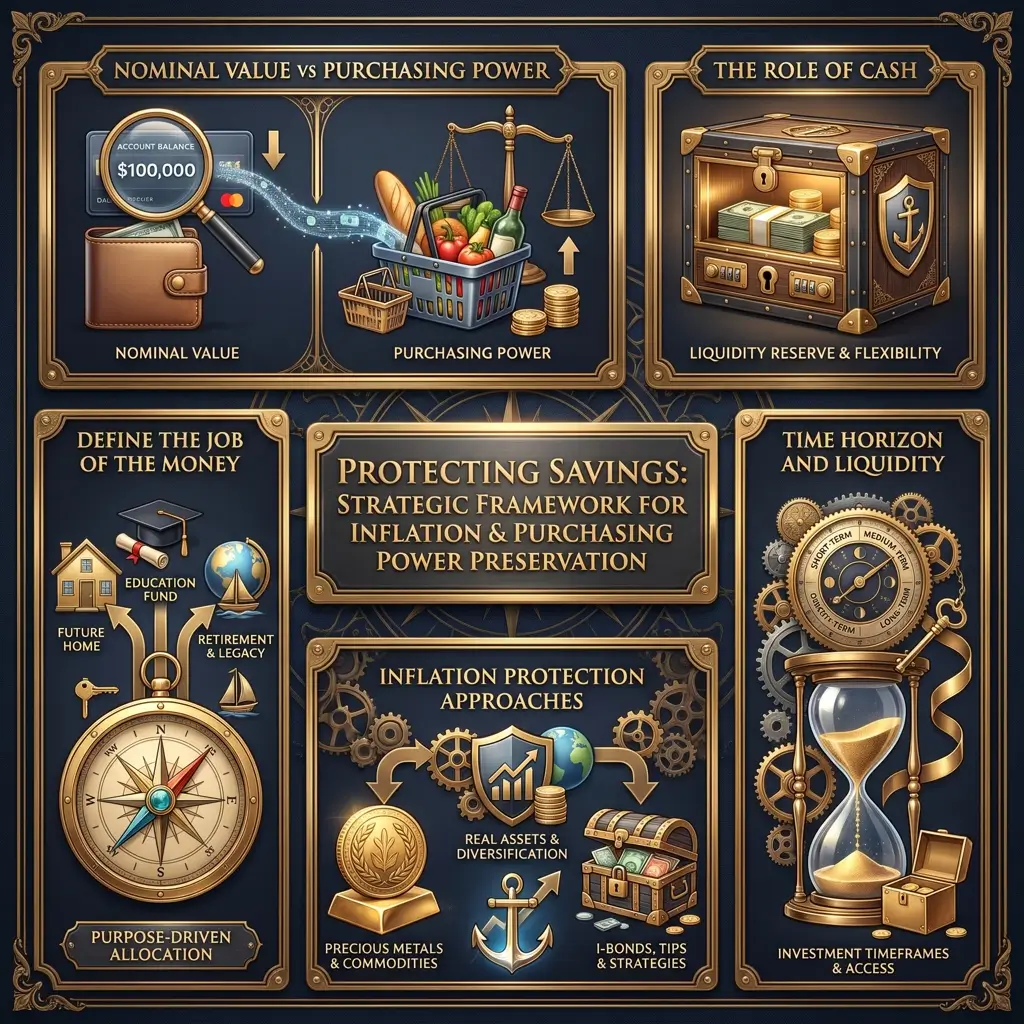
Inflation does not need to take money out of your account to make you poorer in real terms.
Suppose you have $20,000 in savings. One year later, the account still contains $20,000. At first glance, nothing has been lost.
But if the goods and services you regularly buy have become more expensive, that same $20,000 can now purchase less.
This is the distinction between nominal value and real purchasing power.
The number in your account may be unchanged, while its economic usefulness has declined.
A Simple Way to Think About Purchasing Power
Imagine that a basket of goods and services costs $10,000 today. If the same basket eventually costs $11,000, keeping $10,000 untouched has preserved the number of dollars—but not what those dollars can buy.
Over short periods, this difference may not feel dramatic. Over many years, however, the cumulative effect can become much more important.
That matters especially when savings represent decades of work and are intended to support retirement, provide security, or preserve wealth for the future.
Cash Is Not the Enemy: It Solves a Different Problem
It is easy to turn a discussion about inflation into an argument against holding cash.
That would be a mistake.
Cash performs several valuable functions. It provides liquidity, allows you to meet unexpected expenses, reduces the need to sell investments at inconvenient times, and gives you certainty about the amount available for short-term needs.
An emergency fund, next year’s major expenses, and money intended for long-term wealth preservation do not necessarily have the same purpose.
The real question is therefore not:
Should I hold cash?
A better question is:
How much of my money needs the stability and accessibility of cash, and how much is intended to preserve purchasing power over a much longer period?
Different financial objectives require different tools.
The problem begins when all savings are expected to perform the same job.
FROM DURABLE IDEAS PRESS
Gold Coin Investment Roadmap
A practical guide to buying and
owning physical gold with confidence.

What “Inflation Protection” Should Actually Mean
There is no single asset that perfectly protects against inflation under every condition.
That makes the phrase inflation protection easy to misunderstand.
The goal should not necessarily be to find an investment that rises every time inflation increases. A more useful objective is to consider how your wealth can preserve purchasing power over the period in which you expect to use it.
That decision depends on several factors:
- when you will need the money;
- how much liquidity you require;
- how much price fluctuation you can tolerate;
- whether capital stability or long-term growth matters more;
- what other assets you already own.
Every potential solution introduces trade-offs.
Cash offers stability but may lose purchasing power over time.
Assets with greater long-term growth potential can fluctuate significantly.
Some assets may respond well to particular inflationary environments but poorly to others.
Protecting savings from inflation therefore does not mean moving everything out of cash and into something more volatile. It means matching different parts of your wealth with the risks they are intended to address.
Common Ways Investors Try to Preserve Purchasing Power
Investors use several broad approaches when attempting to protect long-term purchasing power. None is universally superior, and each solves a slightly different problem.
Cash and Short-Term Savings
Cash remains useful for liquidity, emergencies, and expenses that may arise soon.
The limitation is that returns on cash do not always keep pace with increases in the cost of living. That makes it less suitable as the only long-term wealth-preservation strategy.
Inflation-Linked Assets
Some financial instruments are specifically designed to adjust with measures of inflation.
They can play a useful role when inflation protection is the objective, but they still have characteristics involving liquidity, taxation, interest rates, and investment horizon that need to be understood.
Productive Assets
Businesses and other productive assets can potentially increase their earnings and economic value over time.
For long-term investors, this growth can help offset the erosion of purchasing power. The trade-off is that market prices can move substantially in the short term.
Real and Tangible Assets
Real estate, commodities, precious metals, land, and other tangible assets are sometimes considered when investors want wealth that is not represented entirely by fixed monetary claims.
But “tangible” does not mean “risk-free.”
Each asset has its own costs, liquidity characteristics, valuation risks, and practical complications.
The important principle is simple:
There are several ways to respond to inflation. Understanding the problem should come before selecting the asset.
Where Physical Gold May Fit—and Where It Does Not
Physical gold is one of the assets some investors consider when thinking about long-term wealth preservation.
Its appeal is understandable. Gold is tangible, globally recognized, does not depend on the performance of a particular company, and has been used as a store of wealth across very different economic environments.
But those characteristics do not make gold a guaranteed solution to inflation.
Gold can fluctuate in value. It produces no income by itself. Physical ownership also introduces practical questions involving purchase price, premiums, authenticity, storage, insurance, and eventual resale.
Most importantly, gold does not replace the need for liquidity, diversification, or a broader financial plan.
It is better viewed as one possible tool within a larger wealth-preservation strategy.
And even after deciding that physical gold may deserve a place in that strategy, another set of decisions begins: what form to own, where to buy it, how much to pay above the underlying gold value, how to verify authenticity, and how to store it securely.
Those implementation questions matter just as much as the initial decision to own gold.
Before You Move Money, Define What You Are Trying to Protect
Before choosing any inflation hedge, ask yourself a few basic questions:
- When will I need this money?
- How much must remain immediately accessible?
- Am I trying to protect nominal capital or long-term purchasing power?
- How much short-term volatility can I realistically tolerate?
- Is inflation my main concern, or am I also worried about market risk and broader financial uncertainty?
- How diversified are my savings already?
These questions do not produce one universal answer.
They do something more useful: they define the problem correctly.
And that should come before selecting the solution.
Protect Purchasing Power, Not Just the Number on the Statement
Saving remains one of the foundations of financial security. Cash remains essential.
But preserving a bank balance and preserving what that balance can buy are not always the same thing.
Understanding that distinction is the first step toward building a more resilient long-term strategy.
The next question is which assets can realistically help preserve purchasing power—and what trade-offs come with each one.
Next: Inflation Hedges Explained: Which Assets Can Actually Help Preserve Purchasing Power?
Get our free 2026 Gold Investment Starter Pack here