

You have spent three years building a project that no longer seems promising.
You have invested thousands of dollars in something that is not working.
You have stayed in a job, course, business idea, or commitment far longer than you expected.
And one thought keeps coming back:
I’ve already put too much into this to stop now.
That feeling is powerful because walking away can seem like admitting that all the time, money, and effort you invested were wasted.
But there is a problem with that reasoning.
Resources that have already been spent cannot usually be recovered. Economists call them sunk costs. Allowing those past investments to determine what you do next is known as the sunk cost fallacy.
The important question is not how much you have already invested.
It is whether the next investment of your time, money, or energy still makes sense.
Prefer to listen?
This article is also available as a podcast episode.
Listen to this episode on Spotify
Why Sunk Costs Are So Difficult to Ignore
A sunk cost is something you have already spent and cannot get back.
It might be money.
It might be time.
It might be years of effort, training, or emotional commitment.
In theory, the logic seems simple: if the resource is gone regardless of what you do next, it should not determine your next decision.
In practice, that is much harder.
Stopping can feel like admitting failure.
It can make us question earlier decisions. It may threaten part of our identity. Someone who has spent ten years pursuing a particular career, for example, may find it difficult to separate the question:
“Is this still the right career for me?”
from:
“What would those ten years mean if I changed direction?”
The same thing happens with investments, relationships, projects, businesses, qualifications, and even hobbies.
Past effort creates emotional weight.
But emotional weight is not the same thing as future value.
Imagine that you have spent two years developing a business idea. New evidence suggests that demand is much weaker than you expected.
Those two years are real.
They may have taught you valuable skills.
They may have produced useful contacts or knowledge.
But they do not make the third year more likely to succeed.
That decision has to earn its place on its own.
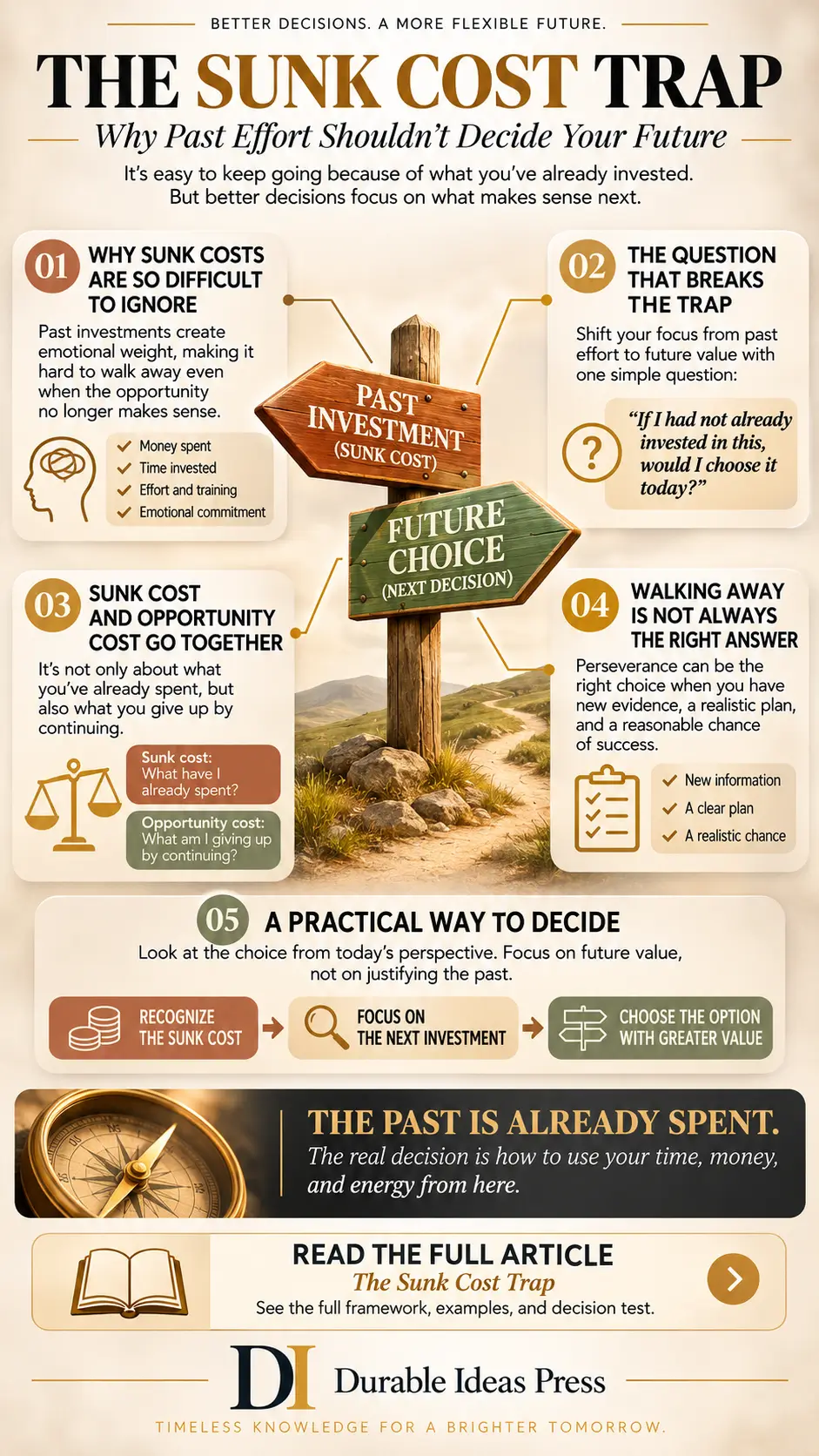
The Question That Breaks the Sunk Cost Trap
One question can make sunk-cost thinking much easier to recognize:
If I had not already invested in this, would I choose it today?
It is a simple question, but it changes the perspective completely.
Instead of asking whether you can justify what has already happened, you ask whether the opportunity still deserves resources from this point forward.
Imagine you are considering leaving a job after several years.
Rather than asking:
“How can I leave after everything I’ve invested here?”
ask:
“Knowing what I know now, would I accept this job today?”
Or suppose you have invested money in a project that keeps requiring more capital.
Instead of thinking:
“I can’t stop now because I’ve already spent $10,000,”
ask:
“If I had not spent that $10,000, would I invest the next $2,000 today?”
The same test works with education, business ideas, subscriptions, personal projects, and many other commitments.
Imagine You Are Starting From Zero Today
Try temporarily removing the history from the decision.
Ask yourself:
- Would I enter this situation today?
- Would I invest this money today?
- Would I commit another year to it?
- Would I choose this project over the alternatives now available?
- Would I make the same decision with the information I have today?
You are not pretending the past never happened.
You are simply preventing it from controlling the future.
FROM DURABLE IDEAS PRESS
Capitalize on Your Hobby
Turn what you enjoy into a tested, sustainable side business.

Sunk Cost and Opportunity Cost Are Two Sides of the Same Decision
There is another concept that makes sunk-cost decisions much clearer: opportunity cost.
A sunk cost asks:
What have I already spent?
Opportunity cost asks:
What am I giving up by continuing?
The second question is often more useful.
Suppose you spend another year on a project that has little chance of producing the result you want.
The cost is not only another year.
It is also everything else you could have done with that year.
You might have:
- tested another idea;
- learned a different skill;
- built a new income source;
- changed jobs;
- recovered time for family or health;
- invested your money elsewhere.
This is why continuing something can be expensive even when no new cash is involved.
Time, attention, energy, and optionality are resources too.
A project may cost very little financially and still be extremely expensive if it consumes the hours you could use for something more valuable.
The same is true in your career.
Remaining in an unsuitable role because you have already spent years acquiring experience may feel safer than changing direction.
But every additional year also delays whatever alternative you could begin building.
The relevant comparison is therefore not:
Continue vs. waste the past.
The past is already spent.
The real comparison is:
Continue from here vs. use the same future resources somewhere else.
Walking Away Is Not Always the Right Answer
There is an important danger in learning about sunk costs.
You can become too eager to label persistence as irrational.
That would be a mistake.
Difficult things often require patience.
Businesses take time to develop.
Investments can go through weak periods.
Skills require long practice.
Important projects often become frustrating before they become valuable.
The sunk cost principle does not mean:
“If something becomes difficult, quit.”
It means:
“Do not continue only because of what you have already spent.”
Persistence and sunk-cost thinking are different.
Rational persistence sounds like this:
“The future benefit still appears worth the future cost.”
Sunk-cost reasoning sounds like this:
“I have to continue because I have already invested too much to stop.”
That distinction matters.
Past experience can also contain valuable information.
Perhaps two difficult years taught you that the market is beginning to respond.
Perhaps a qualification is nearly complete and still opens opportunities you genuinely want.
Perhaps a business has struggled, but the underlying economics are improving.
The past should inform your understanding.
It just should not demand repayment.
A useful decision looks forward.
A Simple Forward-Looking Decision Test
When you suspect that sunk costs may be influencing you, try four questions.
1. If I were starting today, would I choose this again?
This removes the pressure to defend the original decision.
If your answer is clearly no, that deserves attention.
2. What will continuing cost me from this point forward?
Ignore what has already been spent.
Estimate the future cost:
- money;
- time;
- energy;
- stress;
- attention;
- lost flexibility.
The relevant cost begins today.
3. What do I realistically expect to gain from continuing?
Try to separate evidence from hope.
What future outcome are you actually expecting?
What has changed since your original decision?
What evidence supports continuing?
Do not ask whether success would justify the past.
Ask whether the expected future result justifies the future investment.
4. What am I giving up by continuing?
This is the opportunity-cost test.
Every yes is also a no to something else.
Continuing one project may mean postponing another.
Keeping capital in one place means it cannot be used elsewhere.
Remaining in one role may prevent you from building another path.
Once those alternatives become visible, the decision often looks different.
A useful rule is:
If the future case is strong, continue. If only the past case is strong, reconsider.
What If You Know You Should Stop—but Still Can’t?
Recognizing a sunk cost intellectually is much easier than acting on it.
The problem is often no longer financial or logical.
It is emotional.
You may feel that stopping means admitting you made a bad decision.
But changing direction after receiving new information is not necessarily evidence of poor judgment.
Sometimes it is evidence that you are finally using better information.
It can also help to separate the outcome from what you gained along the way.
A project that does not continue may still have produced:
- knowledge;
- experience;
- contacts;
- skills;
- clearer priorities;
- a better understanding of what you do not want.
Ending the project does not erase those things.
Another useful step is to decide what the released resources will be used for.
Walking away can feel like pure loss when the alternative is vague.
It feels different when you can say:
“The next six months will go toward this new project.”
or:
“The money I stop committing here will build my emergency fund.”
or:
“The time I recover will allow me to test another career path.”
That changes the decision from abandonment to reallocation.
The goal is not to recover the past.
It is to make the best use of what remains.
Let the Future Earn the Next Investment
Past decisions matter because they brought you to where you are.
They may have taught you something valuable.
They may have changed your skills, relationships, or understanding.
But they do not automatically earn another year, another dollar, or another hour.
A commitment should continue because its future value justifies its future cost.
Not because the past demands that you prove it was worthwhile.
So when you find yourself thinking:
“I’ve already invested too much to stop now,”
ask a different question:
If I had not already invested in this, would I choose it today?
Your answer will not always tell you to walk away.
But it will force the next decision to compete on its own merits.
And that is usually a much better place to start.
Better decisions often begin with better frameworks.
Durable Ideas Press is developing a new book that translates proven business and decision-making frameworks into practical tools for everyday life.
Join Durable Ideas Press for practical decision frameworks and updates on the upcoming book.