

Some decisions deserve days of thought.
Others deserve ten minutes.
The problem is that we often treat them the same.
We research, compare, ask for opinions, imagine worst-case scenarios, and wait for certainty—even when the decision could easily be reversed a week later.
A new tool. A different routine. A small project. A course. A side experiment. A change in how you organize your work.
We can spend more time deciding than actually testing the choice.
At the same time, some decisions really do deserve caution. Leaving a stable job without a plan, committing a large amount of capital, signing a long-term contract, or making a choice that is difficult to undo should not be treated casually.
A useful way to separate the two is the one-way door / two-way door framework.
The principle is simple:
Reversible decisions should usually be made faster. Difficult-to-reverse decisions deserve more thought.
The value of the framework is not that it tells you what to choose.
It tells you how much decision-making effort the choice deserves.
Prefer to listen?
This article is also available as a podcast episode.
Listen to this episode on Spotify
Not Every Decision Deserves the Same Amount of Thought
When a decision feels important, our instinct is often to reduce uncertainty before acting.
That sounds reasonable.
But uncertainty cannot always be eliminated by thinking.
Sometimes the fastest way to learn is to make a small decision, observe what happens, and adjust.
Consider two situations.
In the first, you are deciding whether to test a new morning routine for two weeks.
In the second, you are deciding whether to resign from your job with no alternative income.
Both choices may affect your life.
But they do not carry the same consequences.
If the new routine does not work, you can stop.
If leaving your job creates financial problems, reversing the decision may be much harder.
Treating both decisions with the same level of caution wastes time in one case and creates unnecessary risk in the other.
This is where the idea of two-way and one-way doors becomes useful.
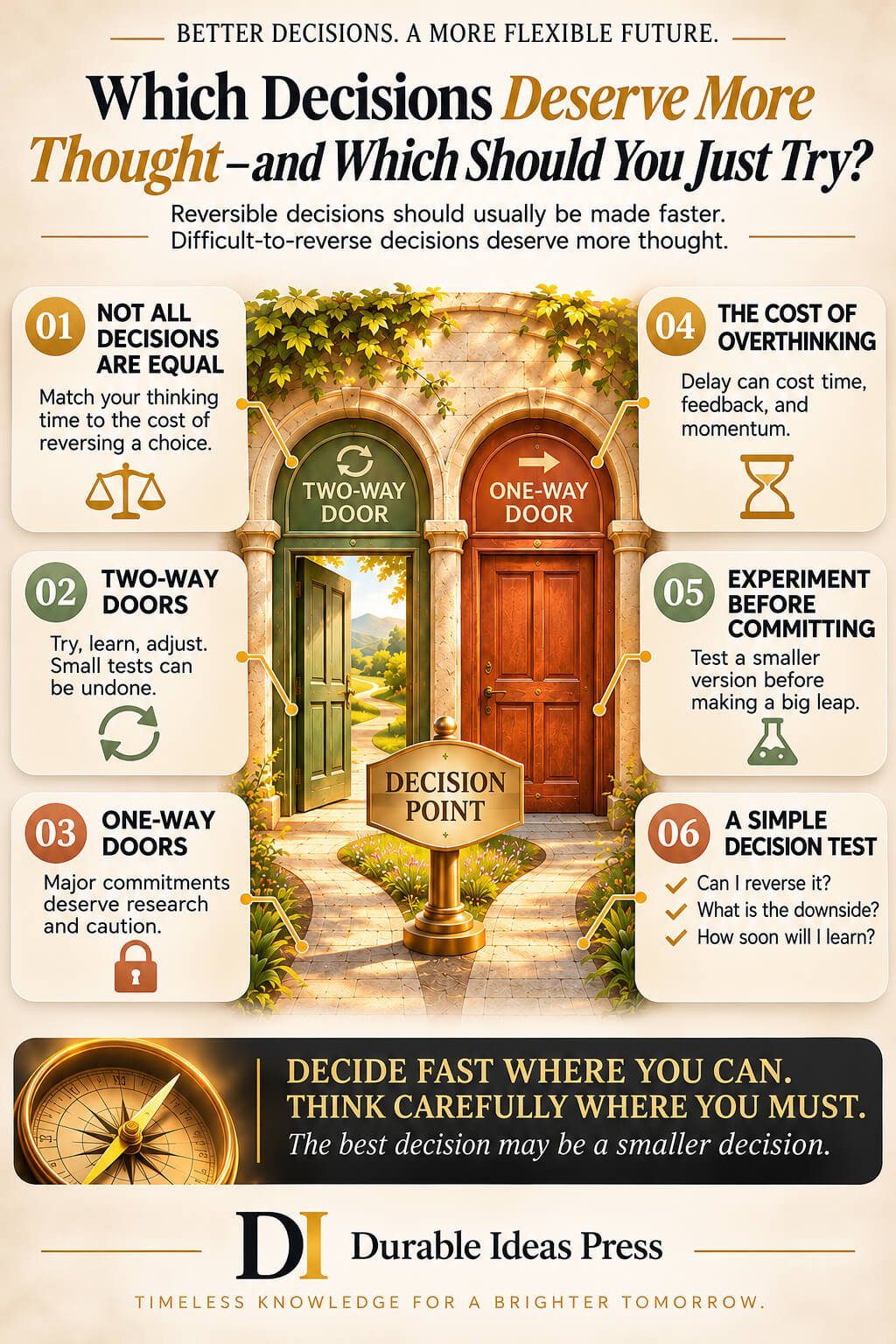
Two-Way Doors: Decisions You Can Usually Reverse
A two-way door is a choice you can make, evaluate, and later undo without excessive cost.
You walk through the door.
If you do not like what you find, you can walk back.
Examples might include:
- testing a new productivity system;
- trying a different software tool;
- publishing a small piece of content;
- starting a short course;
- changing a weekly routine;
- testing a new hobby;
- running a small marketing experiment;
- launching a limited version of a personal project.
These decisions are not necessarily unimportant.
What makes them different is reversibility.
If the result is poor, the downside is limited.
That changes the economics of the decision.
Instead of asking:
“How can I be certain this is the right choice?”
a better question is:
“What is the cheapest, safest way to test it?”
That shift turns decision-making into experimentation.
And experimentation often produces better information than another week of thinking.
One-Way Doors: Decisions That Are Harder to Undo
A one-way door is different.
Once you pass through it, returning may be difficult, expensive, disruptive, or impossible.
Examples can include:
- selling an important asset;
- signing a long-term financial commitment;
- leaving a secure position without preparation;
- making a major relocation;
- taking on substantial debt;
- making a large investment in an untested idea;
- entering a legal or contractual obligation that is difficult to reverse.
These decisions deserve more care because mistakes are costly.
The relevant question is not whether the decision is emotionally significant.
It is:
How difficult would it be to reverse if I were wrong?
A choice can feel dramatic but still be reversible.
Another may appear routine but create years of consequences.
The framework therefore forces you to look beyond emotion and examine the structure of the decision.
The Hidden Cost of Overthinking Reversible Decisions
Most people understand the cost of making a bad decision.
The cost of delaying a decision is less obvious.
Suppose you spend three months researching whether to start a small side project that could have been tested in two weekends.
You may think you are reducing risk.
But you are also paying a price.
You lose:
- time;
- feedback;
- experience;
- momentum;
- information that only action can provide.
This is the cost of excessive deliberation.
Some decisions become clearer through analysis.
Others become clearer only through contact with reality.
You cannot fully think your way into knowing whether you enjoy a particular type of work.
You may need to try it.
You cannot know exactly how people will respond to an idea.
You may need to show it to them.
You cannot predict every difficulty in a personal project.
You may need to build a small version.
When the decision is reversible, waiting for certainty can be more expensive than making a modest mistake.
Experimentation Is Often a Better Decision Tool
The one-way / two-way door framework naturally leads to another principle:
When the downside is limited, design an experiment instead of demanding certainty.
Imagine you are considering a career change.
Changing careers completely could be a one-way or difficult-to-reverse decision.
But investigating the new career does not have to be.
You could:
- take a short course;
- complete a small freelance project;
- speak with people already doing the work;
- volunteer;
- build something on weekends;
- test whether you actually enjoy the activity.
The large decision is difficult to reverse.
The experiments surrounding it are not.
That distinction matters.
Many apparently enormous decisions can be broken into smaller reversible ones.
You do not always need to decide:
“Should I become X?”
You may only need to decide:
“Should I spend the next two weekends testing X?”
That is a much easier decision to make—and often a much better source of information.
FROM DURABLE IDEAS PRESS
Capitalize on Your Hobby
Turn what you enjoy into a tested, sustainable side business.

Reversibility Is Not the Same as Triviality
There is an important nuance here.
A reversible decision is not automatically a decision that should be made carelessly.
Small choices can still have consequences.
And some decisions that appear reversible become less reversible over time.
For example, starting a side project may initially be easy to abandon.
But after investing money, building commitments, or involving other people, leaving may become more costly.
Reversibility exists on a spectrum.
Instead of sorting every decision into two perfect boxes, it may be more useful to ask:
- How easily can I undo this?
- How much would reversing it cost?
- Who else would be affected?
- How quickly would I discover whether the decision was wrong?
- Can I make the first step smaller?
This turns the framework into a practical decision tool rather than a slogan.
When Caution Really Matters
Speed is useful only when the cost of being wrong is manageable.
Some decisions deserve deliberate thought precisely because experimentation is expensive.
Before moving quickly, consider five factors.
1. Financial exposure
How much money could realistically be lost?
A $50 experiment and a $50,000 commitment deserve different standards of evidence.
2. Time commitment
Would the decision consume a weekend, six months, or several years?
Time is often harder to recover than money.
3. Impact on other people
A decision that affects employees, partners, family members, or other people may require more care even if you personally could reverse it.
4. Legal or contractual consequences
Contracts, debt, ownership structures, and other formal commitments can reduce reversibility dramatically.
5. Recovery cost
If you change your mind, what would it take to return to your previous position?
The higher the recovery cost, the more the decision deserves careful analysis.
The purpose is not to become cautious about everything.
It is to reserve caution for the decisions that actually need it.
A Simple Decision-Speed Test
Before spending another hour thinking about a decision, ask four questions.
1. Can I reverse this decision?
If yes, the decision may deserve less deliberation.
2. What is the realistic cost of being wrong?
Look at money, time, reputation, relationships, and lost opportunities.
3. How quickly will reality give me feedback?
If you can discover the answer in a week by trying, experimentation may be more useful than prediction.
4. Can I make the decision smaller?
Instead of committing fully, can you test a limited version?
A useful rule is:
High reversibility + low downside = decide faster and learn.
Low reversibility + high downside = slow down and investigate.
The framework does not remove uncertainty.
It helps you decide when uncertainty should stop you.
The Best Decision May Be a Smaller Decision
One of the most useful applications of this framework is not choosing between “yes” and “no.”
It is redesigning the choice.
Suppose you are considering starting a business.
The decision does not have to be:
Quit my job and build the business
versus:
Do nothing.
You might instead test:
- one customer;
- one product;
- one weekend;
- one landing page;
- one small advertising campaign.
You convert a difficult-to-reverse decision into a series of reversible ones.
The same logic applies to:
- changing careers;
- moving;
- beginning a major project;
- learning a new skill;
- investing in equipment;
- creating a new income stream.
This is often where decision quality improves most.
Instead of becoming better at predicting the future, you become better at designing choices that produce information cheaply.
Decide Fast Where You Can. Think Carefully Where You Must.
Good decision-making does not mean thinking longer about everything.
It means matching the amount of thought to the structure of the decision.
Some choices deserve research, caution, and patience.
Others deserve a small experiment.
The mistake is treating every door as if it locks behind you.
Before your next decision, ask:
If this turns out to be wrong, how hard would it actually be to come back?
If the answer is “not very hard,” you may not need another week of analysis.
You may simply need to try.
If the answer is “very hard,” then caution has earned its place.
The goal is not to make every decision quickly.
It is to stop spending your most limited resources—time and attention—on certainty you do not actually need.
Better decisions often begin with better frameworks.
The one-way / two-way door model is one of several practical decision frameworks Durable Ideas Press is exploring for everyday life.